
Chapman receives a D- free speech ranking
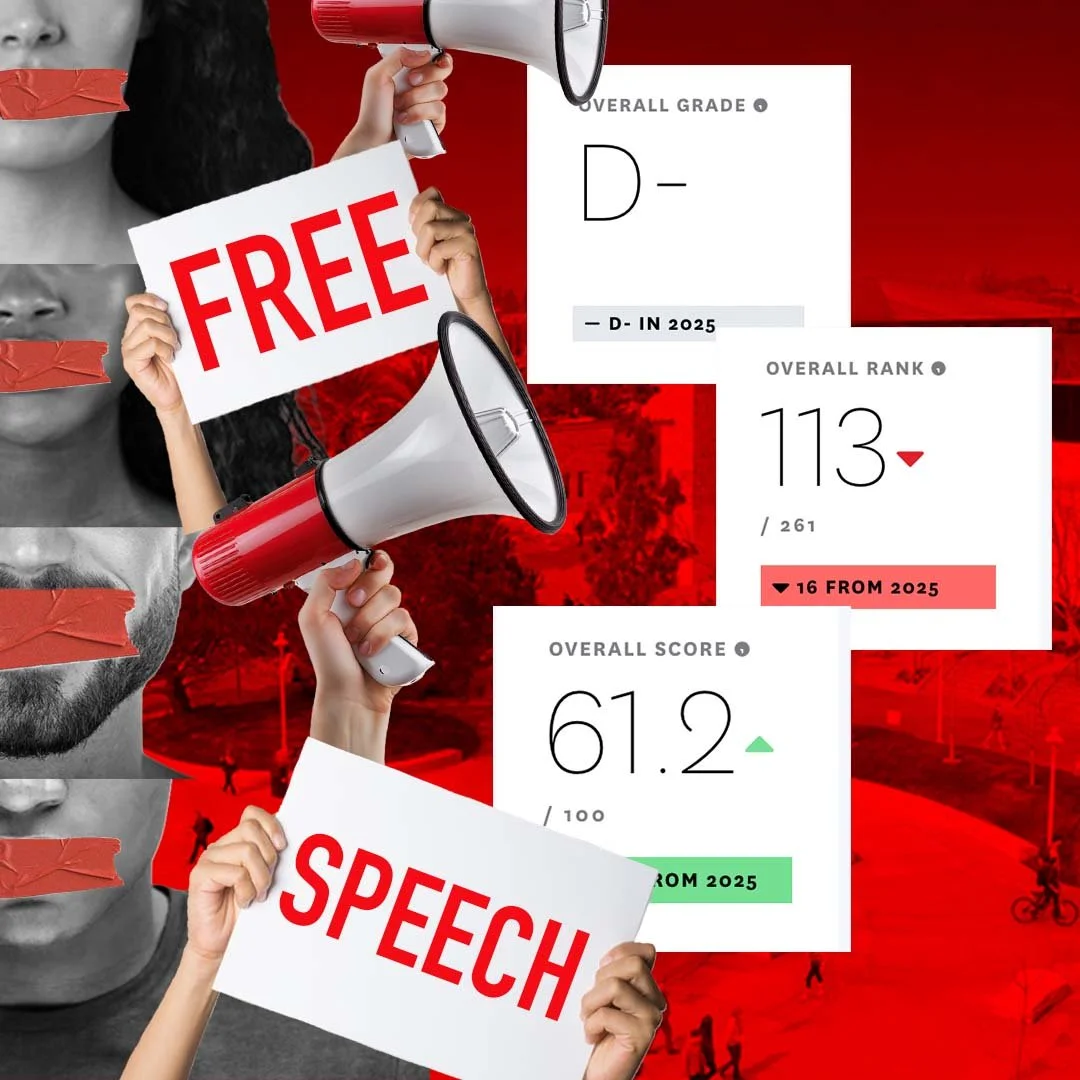
Collage by Trinity Johnson, Photographer
Students may have the right to speak freely, but feeling comfortable enough to do so is another question.
The First Amendment of the U.S. Constitution protects freedom of speech by limiting government restrictions on expression. California law, specifically the Leonard Law, extends certain speech protections to students at private, secular universities. However, legal protections do not necessarily mean students feel comfortable expressing their views on campus.
One way universities are held accountable for their free speech policies is through the annual Foundation for Individual Rights and Expression (FIRE) rankings. Every September, FIRE uses universities’ written policies, College Pulse student surveys and speech controversies to rank 261 educational institutions for the following year and assess whether each campus perpetuates self-censorship among students.
Each school on the list is given a green, yellow or red spotlight rating: green schools provide clear indications of their free speech policies, yellow schools suggest vague policies and red schools impose restrictions on speech.
According to the 2027 College Free Speech Rankings, FIRE ranked Chapman 113 out of 261 universities with a yellow spotlight rating, showing improvement from its 2026 ranking of 181.
This higher rating may be attributed to the university’s adoption of the Chicago Statement, a free speech policy statement created in 2015 by the Committee on Freedom of Expression at the University of Chicago.
Despite the higher ranking, FIRE data suggests that Chapman students feel unable to express their ideas; the university ranked in the bottom 50 in the “comfort expressing ideas” category.
Chapman was given an overall score of 61.2 out of 100, which amounts to a D- grade. According to FIRE data, 37% of students self-censored their speech at least once or twice a month.
Professor and Fletcher Jones Foundation Endowed Chair in Free Speech Vikki Katz believes that the “politically purple” climate at Chapman and in the broader Orange County community could factor into students’ decisions to censor their speech.
“It’s a purple campus in a purple county, but I think there are elements of Southern California where it’s not nice to be in disagreement with some people,” Katz said. “I think we could come up with some creative ways to reduce that cultural element and help people understand that it’s not impolite to disagree or debate with someone.”
Despite Southern California’s standards of “friendliness” potentially affecting students’ comfort with communication, private school Claremont McKenna College has consistently received top rankings from FIRE.
The 2027 rankings placed the college at two out of the 261 universities with an overall score of 80.13 and a B- grade. It ranks in the top 25 in the “comfort expressing ideas,” “administrative support” and “openness” categories, suggesting students’ confidence in expressing themselves. The college also uses the pro-free-speech Chicago Statement and provides an official statement about institutional neutrality.
Claremont McKenna College has 2.67 liberal students for every one conservative student.
Occidental College shares a similar location and class size with Claremont, but the institution is ranked at 218th, down from 151st in the 2026 College Free Speech Rankings. It has an overall score of 55.5 and holds an F grade. FIRE data says that Occidental College has not implemented the Chicago Statement for Free Speech or institutional neutrality.
The campus consists of 15.50 liberal students for every one conservative student, possibly indicating biases towards students who don’t identify as liberal.
While FIRE rankings can provide an overview of institutions’ free speech policies, they are not the only component in analyzing a campus’s culture.
“There’s a gap between measurements and how people actually experience something,” Katz said.
Similarly, Bob Hitchcock, Chapman’s director of strategic communications, says that the university is dedicated to supporting all its students on campus.
“The University also has a long and faithful tradition of supporting free expression and civil discourse, even when topics are complex or controversial,” Hitchcock said. “All the while, the University aims to foster a safe, respectful and inclusive environment for all members of the Chapman community.”
Effective methods for promoting a healthy free speech culture include valuing diverse perspectives in class discussions and hosting campus events with speakers of varying political ideologies. Ultimately, using methods that encourage diverse perspectives without harming particular groups strengthens campus communities.
“There’s a very big difference between harm and discomfort,” Katz said. “Harm is not caused by having to engage with ideas, histories, people and ideologies that you personally don’t agree with.”