
Abuse and assault allegations upend César Chávez’s legacy
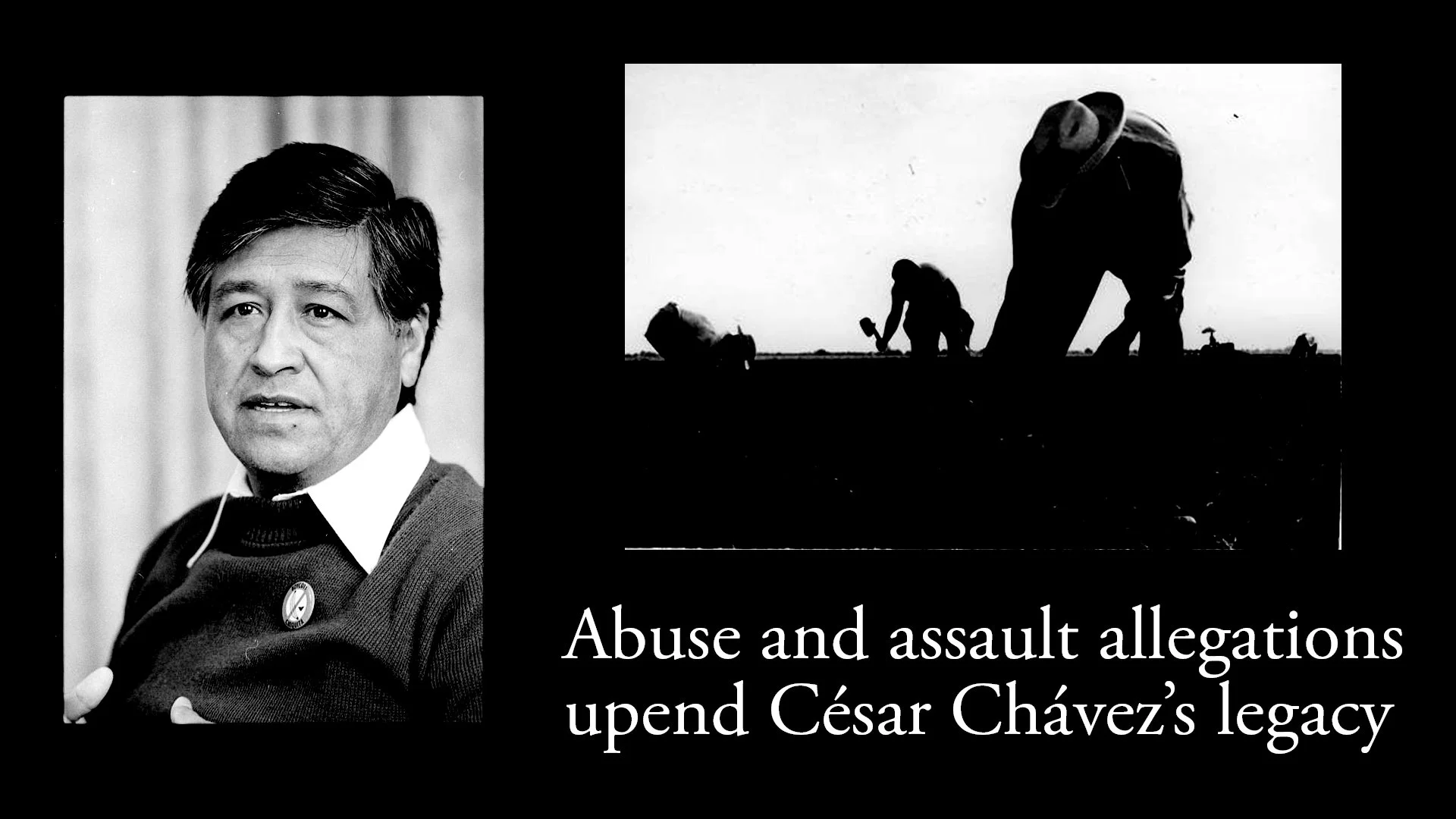
Collage by Easton Clark, Photo Editor
Statues torn down or covered, parks and schools renamed and retitling a holiday are only a few signs of Southern California’s response to the actions of a man who died over three decades ago.
César Chávez, an activist and labor unionist who co-founded the United Farm Workers Union (UFW), has been accused of abusing girls and women in the UFW via a New York Times investigation.
“It’s hard because (Chávez) is credibly accused,” said Gustavo Arellano, a Chapman lecturer and Los Angeles Times Columnist. “The two groups who were most invested in the myth of César Chávez, the César Chávez Foundation and United Farmworkers, before the New York Times article came (out), they put out their statements basically saying, ‘We stand with survivors.’”
On March 17, the UFW issued a statement announcing that they were taking the “disturbing accusations” seriously and would be canceling all César Chávez Day activities that were forecasted for March 31, Chávez’s birthday.
Similarly, the César Chávez Foundation’s statement said they remain committed to the goals of community empowerment and social justice.
“To the survivors: we believe you. We honor your courage, and we are very sorry for the harm you have carried in the shadows for so long,” said the foundation’s statement.
Director of Latinx and Latin American Studies Sandra Alvarez, recognized the impact the Me Too movement and other assault cases — such as those against Harvey Weinstein and Jeffrey Epstein — have had on the responses to the allegations against Chávez.
“In our society we have to reckon with the fact that sexual assault is very underreported, it's very little prosecuted, and so these moments are really important to raise awareness that this happens a lot,” Alvarez said. “(People) have been trying to figure out how there can be accountability.”
Among those who brought the accusations against Chávez was Dolores Huerta, an activist and co-founder of the UFW.
“Its kind of mind-boggling that a 95-year-old woman can share this secret and people don’t want to believe it,” said Alvarez.
Alvarez said Huerta’s lack of recognition in comparison to Chávez for her role in the UFW indicates the remaining patriarchal elements in society, such as viewing women as supporting figures rather than leaders, and not believing them when they speak up about acts of violence.
“Huerta expressed she put her own personal assault to the side because she knew it could be used to decimate this movement that was advocating for such important things as having water, as having restrooms, as having tools that weren’t back-breaking,” Alvarez said. “These are basic human rights, and unfortunately, our society teaches us that women kind of have to be quiet about a lot of stuff to help out the larger group.”
Arellano also recognized the recency of Chávez’s impact as a reason people are struggling to accept the situation.
“César only died in 1993, that's not that long ago,” he said. “These are quotes, books (and) actions that we have been taught about for decades, and now it’s supposed to be a lie because he turned out to do some horrible things? It’s a little bit more complex than just saying ‘nope’ and throwing him away.”
Universities have reckoned with the allegations differently. Renaming buildings, programs and covering up remembrances are only a few measures that have been taken.
While Chapman doesn’t have any buildings or programs dedicated to Chávez, the university takes part in preserving and promoting the “El Proletariado de Aztlan” mural painted by Emigdio Vasquez on Cypress Street. The mural depicts Mexican-American history and includes Chávez in the scene.
It is unclear at this time whether Chapman will take any measures regarding the mural. While the Phyllis and Ross Escalette Permanent Art Collection Director Fiona Lindsay Shen said that senior leadership is discussing the situation, she did not offer further details.
Also on campus, Chapman’s Cross-Cultural Center held a Celebrating Farm Workers Across Cultures Luncheon on March 30. According to Latinx and Latin studies Professor Ruben Espinoza, the event was originally planned as a César Chávez Day celebration.
After the news broke about the allegations, the event was reworked to focus more broadly on farmworker history and collective activism rather than Chávez as an individual figure. However, even before this, Espinoza said those involved were planning to discuss the complexities of Chávez.
“From a critical perspective, he was always a flawed individual,” Espinoza said. “Not everyone supported him. He was anti-immigrant initially, and then became more pro-immigrant later on.”
Additionally, Arellano said his heroic reputation has been on the decline.
“César’s reputation has been sinking over the past 10-15 years,” he said. “Sad to say, (but) he kind of lost it in the 1970s when he basically created a commune.”
The impact of Chávez’s actions extends beyond campus events and into the classroom, where Chávez will continue to be taught, but now with added context.
“He’ll still be in the classroom, he’s not gonna go away, we’re just gonna be talking about him differently,” said Espinoza. “I will mention it, but it will be with the understanding that later on, we found these things about them, but the movement itself happened. You don’t erase the history of the people who struggle for those rights.”
Arellano also hopes that Chávez will not be erased from the curriculum, but has heard otherwise in lower education.
“My friend, she has a son in kindergarten, and they were all doing reports on Latino heroes in the lead-up to César Chávez Day,” he said. “Then the son comes back and said, ‘We can’t learn about César Chávez anymore.’”
For Espinoza, his family’s personal connection to the UFW continues to shape how he interprets the labor movement. Espinoza’s father worked for a vineyard company and was a member of the UFW, which provided multiple benefits, including the ability to afford a house and the money to pay for his mother’s medical bills after a heat stroke while working in the fields.
“I’m able to see that it wasn’t just Chávez that did all that,” he said. “It was an entire community coming together and fighting for those rights that ended up doing it.”
Arellano said that if there's anything to take away from this, it’s that he hopes society will move away from the habit of hero worship.
“There are so many (activist) names out there, but we always look for huge names that have national influence, and I’ve always had a problem with that,” he said. “We all have people we admire — all of us, that's just the human spirit … (But) people are more complex than just black and white. So, same thing with César. The good that he did was really good — and he did do good, you cannot erase that — but the bad he did was about as bad as you can get.”