
Are paper exams making a comeback?
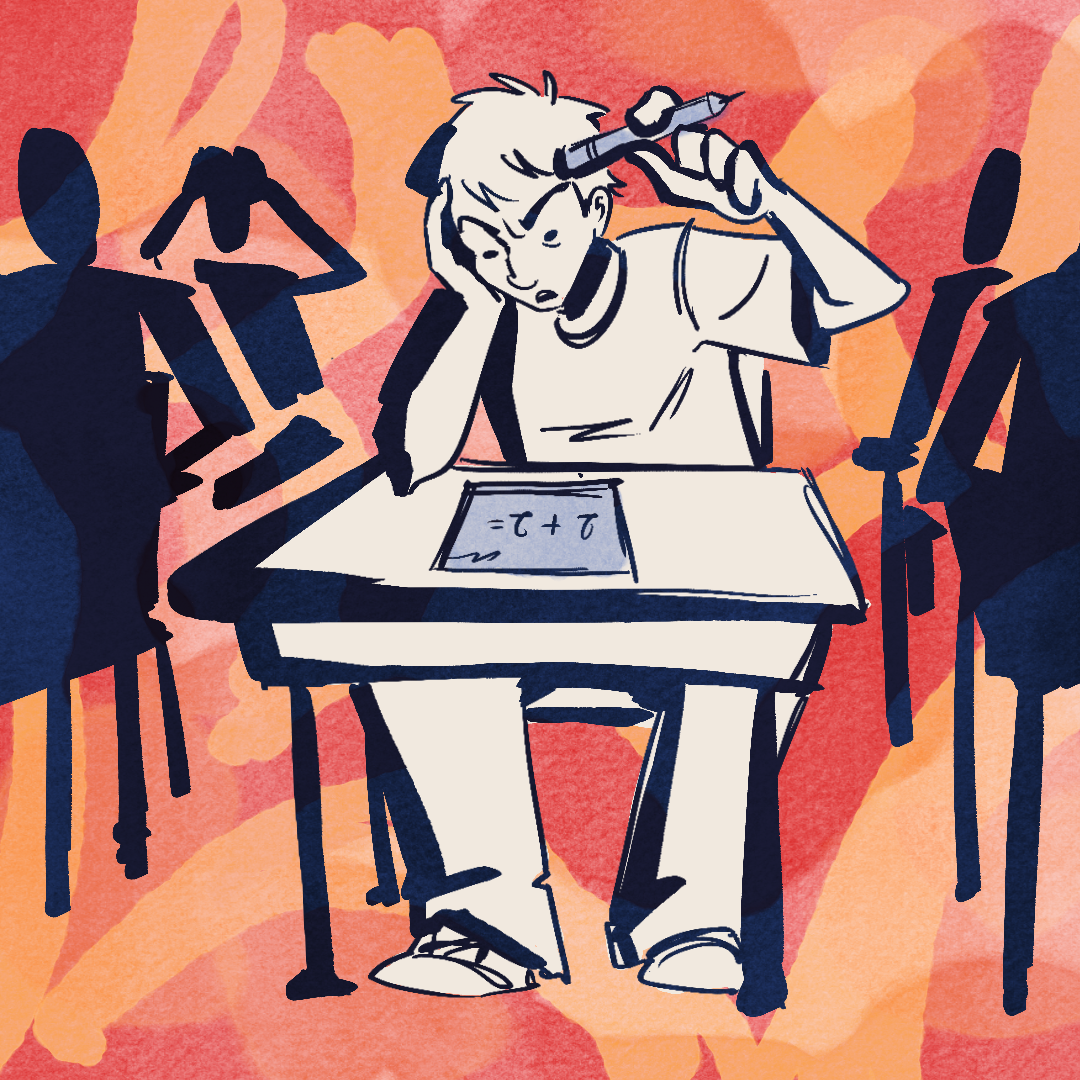
Illustration by Lexi Forman, Cartoonist
For junior biological sciences major Ava Martin, a pencil and a sheet of paper can make an exam easier to navigate. She likes being able to underline questions, annotate the page and work through problems without a screen between her and the test. Her experience reflects a broader shift happening on college campuses, where paper exams are making a return — Chapman included.
According to a report in The Chronicle of Higher Education, there is a nationwide increase in blue book sales. Blue books are paper testing booklets used for writing short answers and essay questions and are often leveraged in higher education. Their sales have now surpassed their pre-pandemic numbers, according to Follett, a campus bookstore seller.
When asked whether using paper exams is more of an academic enrichment tool or of cheating prevention, Assistant Professor of chemistry Nadia Hirbawi said it was “about 50/50.”
“I feel like [online tests are] not very accessible,” Hirbawi said
Hirbawi said a drawback of online testing is that not every student may have access to reliable technology, but they will always have access to a pencil and paper.
Hirbawi explained that in classes like chemistry, paper testing is more convenient and practical, since students often have to draw scientific models.
The nuances of each course directly influence a professor's decision to use paper testing materials. However, it's not only classroom logistics that drive professors to utilize paper exams in their coursework.
Scott Anderson, an accounting instructor, says a vital aspect of accounting is understanding the associated vocabulary.
“[Paper exams] challenge students to rise to something heightened,” Anderson said. “[It’s] the only way we're sure they've learned anything.”
Anderson said that implementing rigorous paper exams is the superior way to achieve this retention and overall benefit students in their careers.
Students are also experiencing the first-hand benefits of paper exams.
“Having that pencil-to-paper contact, I feel like it helps me process better,” Martin said. “You can underline the questions and annotate everything to make sure you're comprehending it.”
While at Chapman, Martin noted that most of her exams have been on paper, except for her anatomy class. Due to class size, examinations were instead conducted on a lockdown browser to streamline grading.
While it is unclear how Chapman compares to the national trend line of paper exam use, many professors who are choosing to implement this change are doing so not out of fear of AI or distrust for their students, but out of a genuine belief that it is the best choice for the education of their students.