
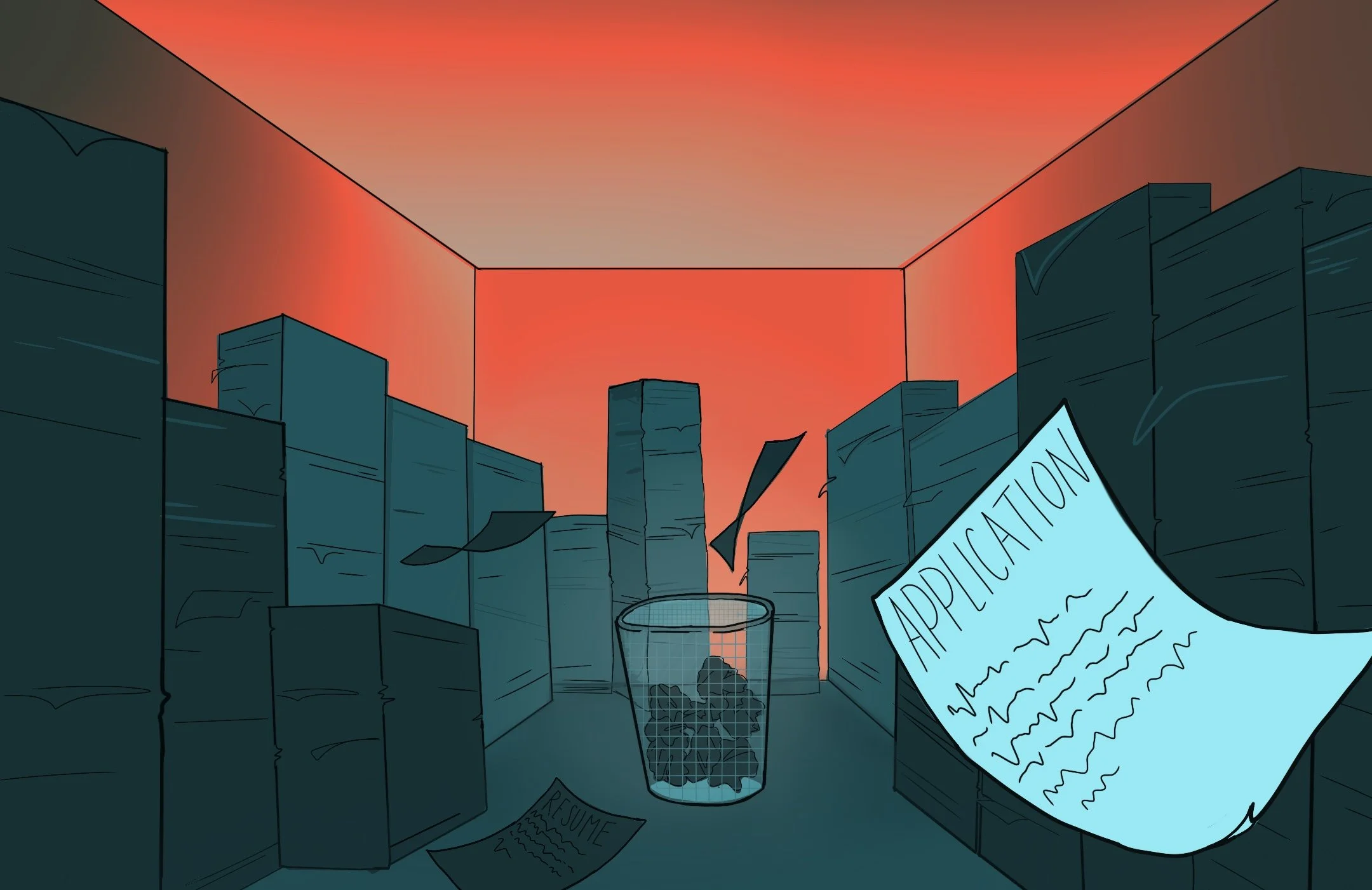
Illustration by Zoe Arntsen, Illustrator
On Sept. 9, the Bureau of Labor Statistics released a jobs report, revising the estimated number of jobs added from last year through March down by nearly a million. It’s the latest in a series of economic woes that have some students at Chapman, both current and graduated, worried about their futures.
For students like film and television production major Sparrow Gilligan, who expects to graduate in 2026, the primary concern is entry-level positions.
“I’m doing everything in my power to get a job as an assistant editor or post-production assistant, ideally in the horror realm,” said Gilligan. “At first, it was a bit more hopeful, but now people aren’t afraid to tell me that there’s an extreme lack of entry-level positions for editors — and everyone in film, for that matter.”
It’s an issue that even extends down to younger undergraduates. Adam Vanden Bergh, a computer science major graduating in 2028, stated that while he is aware of the difficulties, he also sees some benefit in the challenge.
“The standards are crazy, but it's also good because it makes people try to strive for greater academic success as well as getting more involved in the industry,” he told The Panther.
Job market woes aren’t just an issue for students currently enrolled at Chapman. As attested to by Wilkinson College of Arts, Humanities and Social Sciences career manager Erin Berthon, an increasing number of alumni have sought out help from Chapman with their own career paths.
“This month, I think I've had about five or six (alumni) a week reach out to me,” said Berthon. “I'm supposed to only see Wilkinson alumni, but we have a lot of alumni that have a minor (within Wilkinson). So that just opens the population even bigger.”
Historically, a common career strategy for college students was to acquire at least one internship while completing their studies. In a study completed in 2024 by the National Association of Colleges and Employers, researchers found that over two-thirds of graduating seniors had participated in at least one internship prior to graduating. But with the pool of applicants growing every year, students are finding it increasingly difficult to get an internship.
“Right before I moved in for my sophomore year of college, I listened in on a seminar for NASA about interning at NASA,” said Vanden Bergh. “And through the hour-long discussion that they had with us potential interns, you can kind of see the criteria start to get more strict than you previously would think — they said out of the 750 applicants you get for one position, only two of them get accepted to the internship.”
Even for students like Gilligan who have been able to get internships, their prized placement on applications may be offering diminishing returns.
“I joke that having this kind of professional experience a few years ago would’ve been enough to help me sleep at night,” she said. “But currently, it feels like there’s a huge mountain to climb to even get my resume noticed by a recruiter. There’s a ton of luck involved; perhaps more required than there should be.”
Another factor that has students concerned when it comes to the job market is the increasing presence of AI across various industries. In a jobs report by the World Economic Forum, 40% of employers say they plan to reduce their workforce by using AI to automate tasks.
“I have only concerns regarding the future of the job market, but it’s never a ‘good’ time in our industry anyway,” said Gilligan. “Things happen: strikes, AI, mergers, you name it. Things are ever-changing in the film landscape, and you have to learn to roll with the punches.”
The same jobs report found that two-thirds of employers plan to hire employees with AI-oriented skills, which may offer a gap in the industry for new applicants. It’s a gap that Berthon plans to help educate students to take advantage of.
“I'm teaching a workshop on AI, and it was interesting…In the workshop, we're going to talk about getting to know what your job is like, what you want to do, and how they are using AI,” Berthon told The Panther. “So when you are in the interview, you're one notch above the person that’s interviewing next to you. So you're a little bit more aware and seeing how you can contribute.”
In the face of worries, Chapman continues to offer a range of services that assist students in the hunt for jobs, some of which were mentioned by students who talked to The Panther.
“I cannot extend enough gratitude towards the Dodge (College of Film and Media Arts) Career Center,” said Gilligan. “From starting with the student workers to working with the full-time staff there, I firmly believe that they are responsible for a lot of my success with obtaining internships, and having the tools to make the most of them.”
Vanden Bergh advises beginning your search at the career fair.
“I went there my freshman year just to take a look at some of the booths, what people were talking about, what people are looking for — which I think is the most important thing because you might want something, but it might not be available,” said Bergh.
For Berthon’s part, she is adamant that one of the best things students can do is maintain connections.
“I think constantly networking, just constantly keeping connections with people (is vital), because at the end of the day, that's what's going to help you,” she said. ”Our Chapman alumni are the best people to network with. They always want to help each other.”