
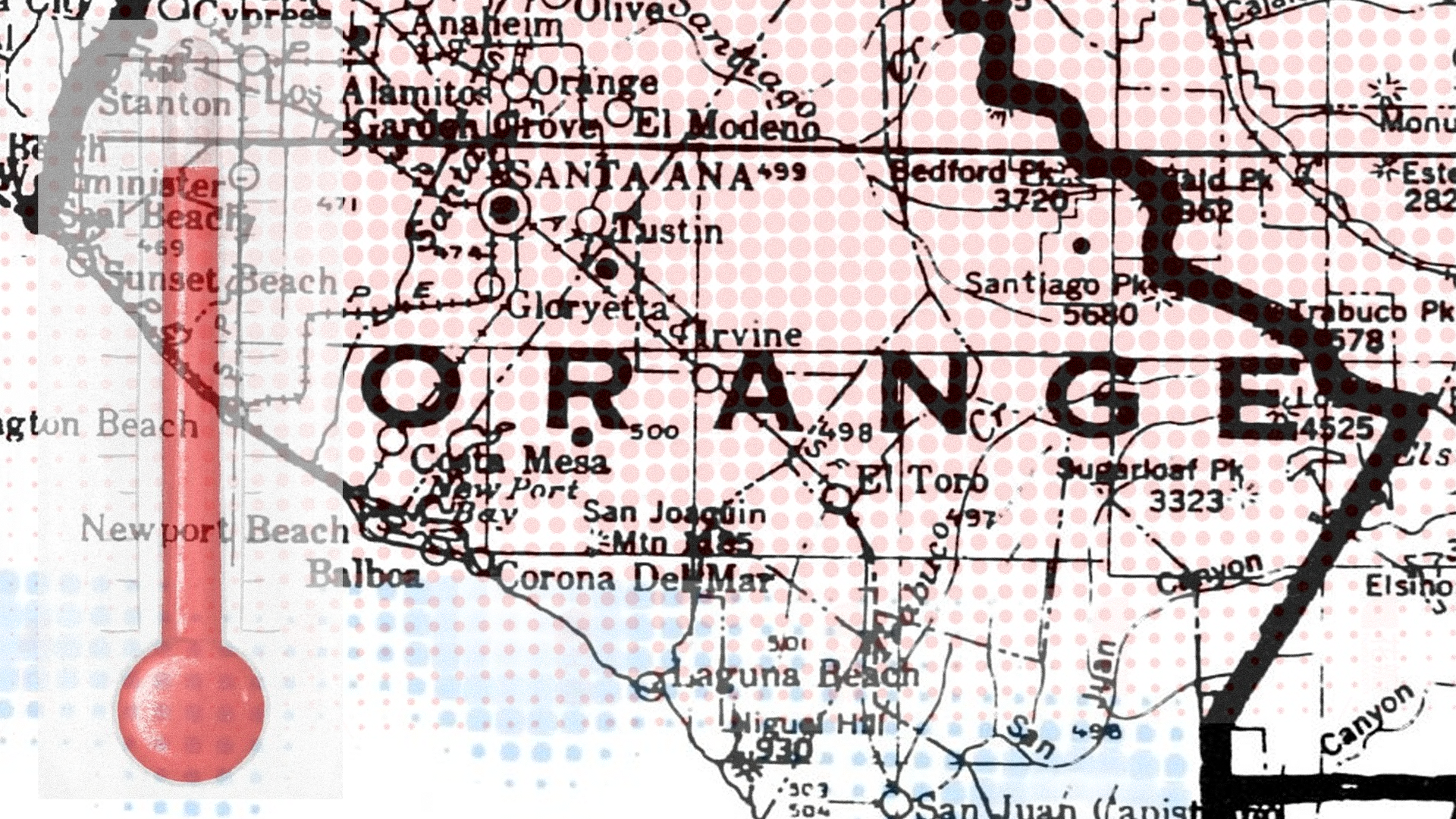
Collage by Riley LeBlanc, Photographer
It is widely acknowledged that navigating life as a student in the sweltering heat is far from ideal. This truth is now scientifically acknowledged and proven.
In a 2026 study, it was found that the grounds of Orange County public K-12 schools reached nearly 122 degrees Fahrenheit – these dangerous temperatures affecting nearly 500,000 students.
This research was led by Gregory Goldsmith and Joshua Fisher, both associate professors in Chapman’s Schmid College of Science and Technology.
Fisher began his career at NASA's Jet Propulsion Laboratory (JPL), where he launched the ECOSTRESS mission to the International Space Station, an experiment that will monitor one of the most basic processes in living plants: the loss of water through the tiny pores in leaves
Goldsmith and Fisher proposed to NASA that they create a class at Chapman using ECOSTRESS to teach students how to analyze data, track climate disasters around the world and explore related topics.
Goldsmith explains ECOSTRESS as a thermal infrared radiometer, or a very fancy camera, capable of measuring the heat emitted from Earth’s surface.
This thermal infrared radiometer is very high-resolution and allowed the team of researchers to observe school-ground temperatures in great detail, which wasn’t possible before.
Environmental science and policy students at Chapman, especially those local to Orange County, focused on researching how heat affected their communities using the data available to them.
This research was initiated by Gabriella Dauber, a Chapman alum, focusing on Orange County public K-12 schools. It was then passed on to another recent Chapman graduate, Joaquin Mariao.
Dauber's interest focused on the surface temperatures of the school grounds in her hometown, and she wanted to investigate why the surface heat varies at each school.
It quickly became apparent that this study demonstrates not only an environmental issue but an environmental injustice. Fisher said the issue affects more than just Orange County.
Ashley Agatep, an environmental science and policy senior, also published research on how these heat inequities have affected Los Angeles County schools.
These dangerous temperature spikes are harmful not only to the environment but also to the communities living in these hotter areas and the children attending school on these campuses.
“If you've got asthma, which is very common in Orange County, and around cities more broadly, then it can be exacerbated by increased heat,” Fisher said.
Because the State of California requires public schools to provide outdoor recess, these students are outdoors during these heat waves. These heat waves could worsen students’ health issues.
“We end up seeing death tolls rise under heat waves, as well as hospital admissions,” Fisher said.
This research shows a correlation between environmental issues and social justice issues.
“Environmental justice inequities associated with [global warming], whether explicit or implicit coincidence, it doesn't matter,” Fisher said. “What matters is that it exists.”
Vulnerable populations will see more intense, immediate negative impacts of global warming. Research like this, and much more to come with ECOSTRESS, will show these low-income minority communities the inequities they're facing.
“For administrators and policy makers, this should be a wake-up call that we need to act to protect our students,” Goldsmith said.
With research like Goldsmith and Fisher’s or Agatab’s, policymakers can’t deny that global warming is affecting their communities.
“This research is really effective in driving policy,” Fisher said. “Policymakers can combat words with words, and that's easy to do. But to combat science with science is hard if the science is right.”