
Paid parking arrives in Old Towne Orange, for better and for worse
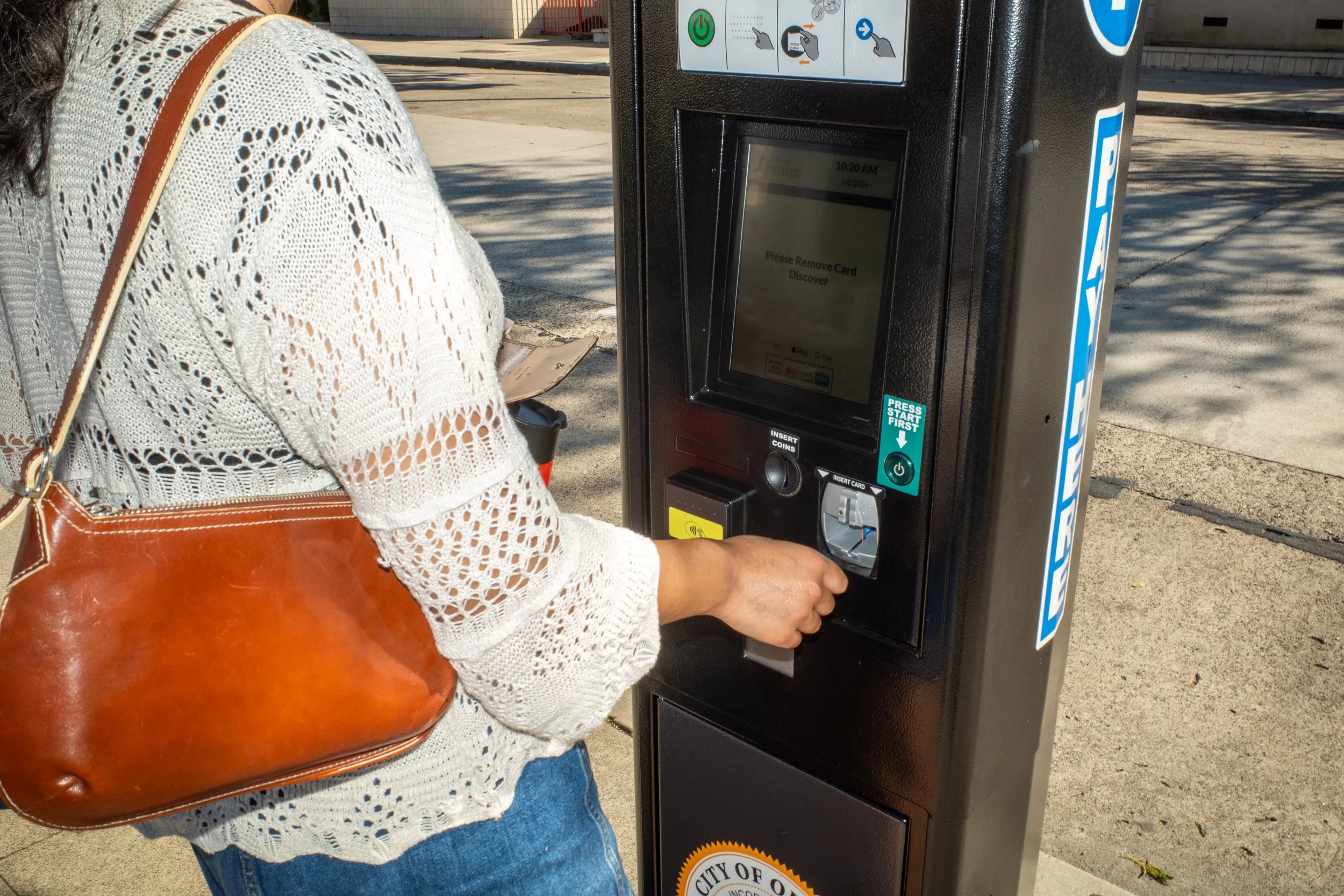
Photo by Easton Clark, Photo Editor
Under the new paid parking system which started in early February, drivers now pay hourly rates through kiosks or mobile apps in designated zones around the Orange Circle.
Some business owners eagerly awaited the change.
Mike Hernandez, co-owner of Smoqued BBQ and 1886, said the city’s growth — especially the increase in restaurants — began to outgrow the area’s parking infrastructure.
Jack Carlisle, owner of The Potting Shed, agreed, saying parking congestion has been building for years as the Old Towne Orange Historic District continues to grow.
Under the new system, city leaders hope employees are encouraged to park in designated areas farther from the Circle, leaving the closest spaces available for customers.
“I think it’s a fantastic thing,” Hernandez said. “Once people realize how easy it is to come here for lunch and find a parking spot, they’re going to start coming back.”
To maintain foot traffic, Orange City Councilmember Arianna Barrios recommends businesses work out assigned parking for their workers. Unlike customers who make short visits, workers need parking for several hours, making the hourly rates unfeasible.
Echo Ellis, who works at the Orange County Antique Mall, said that the parking transition has been difficult for many workers.
“We were never really told where we were supposed to park,” Ellis said. “We didn’t find out until days before it was happening.”
Ellis said some employees eventually created their own map of available free parking areas after the change took effect.
“One of my coworkers made a map because we were having so much trouble finding places to park,” Ellis said. “There’s maybe five or six places total in all of Old Towne Orange where employees are allowed to park for free.”
Even with those locations identified, Ellis said the distance can create challenges for vendors who sell antiques in the district.
“A lot of them are older and really aren’t physically capable of hauling stuff multiple blocks back and forth,” Ellis said. “For a lot of people, that’s how they make their money.”
Safety is another concern for employees finishing late shifts.
“I’m always concerned for people who work here really late, like in the bars and stuff, having to walk alone multiple blocks to their cars if it’s dark,” Ellis said.
Hernandez agreed, saying the city may still need to address that issue as the parking system evolves.
“A lot of my employees are girls who work late at night,” Hernandez said. “They’re walking two blocks away to the parking structure at midnight.”
Questions also circulate about how the revenue from paid parking is benefiting city services.
As Chapman continues to buy property and land, Barrios said the city is facing increasing financial pressure as those properties are removed from the city’s tax rolls.
Barrios says the amount of university-owned property has steadily increased over the past decade and should be part of a larger conversation. One proposal being discussed between the city and Chapman is a “Payment in Lieu of Taxes” (PILOT) program, a partnership model used by many cities and universities. With a voluntary payment made, they help fund public services that the university benefits from, such as police, fire and infrastructure.
“With Chapman having just announced that they’ve crossed the threshold of a $1 billion endowment, we really look to the university to be a better partner and help pay for some of the services (provided),” Barrios said.
The PILOT program is expected to be discussed at a future city council meeting, though Barrios said parking revenue has already helped close some budget gaps and fund services like street cleaning in the Circle.
Meanwhile, for employees like Ellis, the work starts before clocking in, making parking a new part of the job.
Editor’s note: A previous version of this story contained an inaccuracy as to what restaurant Mike Hernandez owned.