
We’re turning 100!
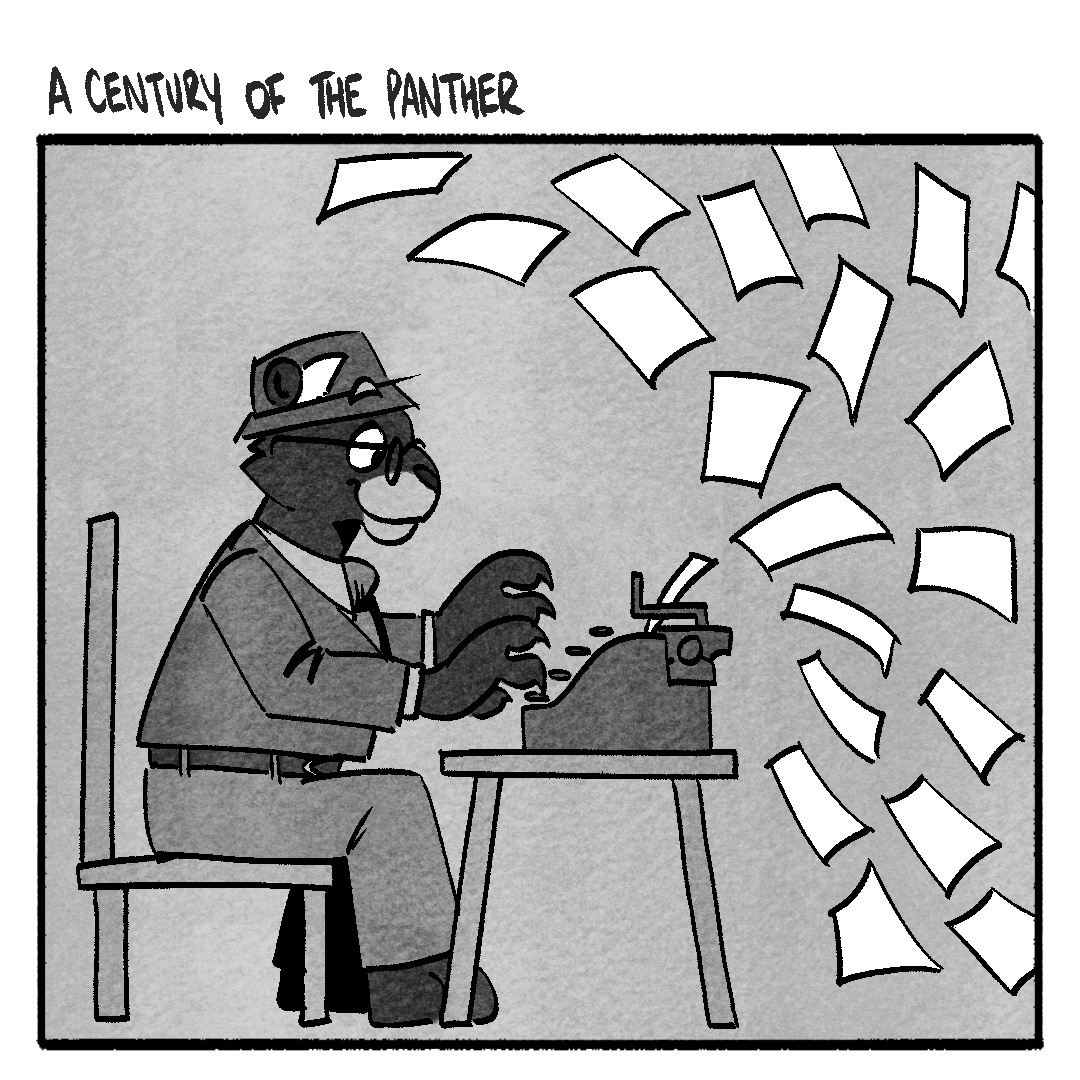
100 years ago this academic year, a handful of students at a small college in the part of Los Angeles known as Koreatown came together to publish a weekly newspaper. They called it The Panther's Meow.
That small college is now known as Chapman University, and the paper is now called The Panther. That’s us.
We don’t know what was in the very first edition or exactly when it was published, but we do know this: The Panther turns 100 this school year, and we’ve spent hours poring over archived editions of Chapman’s student paper.
We wanted to reflect on the last century of student journalism and how The Panther has grown and evolved over its publication history. It’s about time we popped open a bottle of champagne and patted ourselves (alongside generations of our predecessors) on the back. So please, join us as we look back at the campus culture and controversies and hear from the editors who were a part of it along the way.
The Early Years (1920s-1960s)
“Pop! Bang! Woof! Grrrr!
What is that awful rattling din
That swells upon the breeze?”
Those three lines were the beginning of a chant that could be heard at Chapman sporting events 100 years ago, and were published in an issue of one of the first Panther newspapers we could find. The edition belonged to Charles C. Chapman, the namesake and founding father of Chapman University, and was shown to us by one of Chapman's incredible archivists, Annie Tang.
At first, The Panther struggled to fly off the newsstands. In January of 1928, the editorial team put out a message stating that unless there was a more hearty subscription of dimes, they wouldn’t be able to continue. The publication was printed weekly for a very small student body with a typical class size of fewer than 100.
Then, as now, The Panther covered student government news.
Notably, on March 21, 1939, when they published a story about revisions to the “long neglected” constitution and formation of the Student Executive Committee (now SGA), stating that “for many years now the constitution has needed revising but no one could even find an accurate copy.”
The Panther reporters did more than just report on serious matters in the early years; they had their fair share of fun as well.
On May 26, 1939, they published the Jeer, a satirical spin-off of the student yearbook the Ceer. “War declared,” “Blake passes moron test” and “Stupid exec indicted for immorality” ran as top headlines not too dissimilar to something you’d see in an edition of The Kumquat today. A notice at the bottom of the Jeer stated that the satirical edition was “purely for fun and practically everything appearing is of fictitious nature.”
Early editions of The Panther hardly resemble the folded newspapers you’re used to seeing today (or used to not seeing, given the diminishing ubiquity of print media) and were printed largely on loose-leaf paper or once-folded cardstock. You can feel the ramshackle charm of each issue through the page; these were, after all, students working with whatever resources they could muster.
The Panther didn't cover much of World War II because the newspaper wasn't published then. When the war started, nearly all of Chapman's students left to join the war effort, and the Chapman campus was rented to the Navy.
Chapman was founded as a religious college, and The Panther did its part to promote that fact. In 1954, it published a “History of Chapman College” that outlined the institution's Christian history and formation.
In the same year, an announcement was published that the campus would be leaving its LA campus. “Chapman may soon sing ‘Orange, Orange, here I come,’” read the headline. This was the biggest story not just of the year but of the decade.
Chapman paid $300,000 for the former Orange High School plant and The Panther stated that Orange is a “beautiful residential town.” The high school now sits across the street from the university.
The Middle Years (1960s-2000s)
The Panther didn't do much politicking in the early 1960s, but the war in Vietnam and the rise of the counterculture changed that. In the late ‘60s and in the ‘70s, The Panther was an angry publication, full of calls for civil rights protections and anti-war demonstrations.
In 1967, at the beginning of the middle years, the zeitgeist at not only Chapman but in America was clear from the headlines. “Ex-POW recalls escape attempts during WW II,” one reads, and “Racial harassment study” was submitted as an editorial comment.
Eric Marchese, class of ‘81, was The Panther’s editor in chief for three semesters prior to his graduation, and recalls how important the newspaper was to him and to Chapman at large.
“Journalism needs papers like The Panther and others at other schools like it,” Marchese said. “And they need a constant influx of students taking an interest in news journalism.”
Chapman’s administrators weren’t always pleased by The Panther’s efforts to hold them accountable.
“They didn't want a free press at Chapman. To them, it was more like — and these are my words — you were just kids playing in a sandbox,” Marchese told The Panther. “You're only going to be here a few years, some of you may transfer out even before you get a degree, and we'll still be here when you leave. So we can just wait you out. But our stance was, you know, we're a newspaper just like any other newspaper.”
Scott Marshutz, class of ‘87, was the editor in chief during his junior year. He spoke to The Panther on some of the challenges the paper faced when its budget was tied to the Associated Student Body (ASB). In those days, The Panther’s editors were hired (and sometimes fired) by the ASB.
“If they started to screw around with the budget and do stuff that wasn’t in keeping with what they were supposed to be doing, we were going to report on it — and we did,” said Marshutz. “I can think of a half-dozen times where we had front page headlines…but it was funny because I was the editor, so I would have to go to (ASB) meetings, and they would look at me like I was the devil. They were almost trying to figure out a way to keep me out.”
Paula Yakubik, class of ‘94, was The Panther’s editor in chief during her senior year. She came to Chapman as a political science major but switched to journalism after taking a class reporting on international issues in Latin America. Fun fact: her daughter, Ashley Kuckler, held the same position during the 2024-25 school year.
In those days, The Panther had a somewhat overworked staff of less than half of what we have now. Around 15 writers and editors would work out of what Yakubik called a truly “dingy office” to print weekly.
“I just remember that Argyros Forum had just been built. So we had an old dingy office in an old part of Chapman, but then we all got to move into our own office in Argyros Forum, which was so amazing. And that year, Mac computers were just starting to come out. So I remember the year that we all got new Mac configurations in the newsroom,” said Yakubik.
Yakubik says her proudest Panther moment came when she organized a vote to change the distribution of student fees and to take the power to hire and fire Panther editors away from the ASB.
Student fees used to go to the Student Government Association (SGA), then known as ASB, which then had the authority to distribute that money however they pleased.
“I remember just thinking like, that's not really how life works. You know, we should be a free press. And the government shouldn't be beholden over us telling us what to do and holding our funds. So, we petitioned the school to separate out that fee,” said Yakubik. “So we had to do this big vote. I remember running around the campus, trying to get people aligned and ready to vote, and the vote passed.”
The story was reported on by The Panther’s staff.
Through the middle years, the newspaper remained entirely physical production, run out of a dedicated newsroom, corkboards lining the walls to pin story ideas, typewriters affixed to desks next to stacks of loose-leaf paper for writers to utilize and a darkroom — more accurately, a closet — to develop the black-and-white photographs that would emblazon the weekly eight-page publication.
Most of that is gone now, we should note. The Panther still publishes print editions, but only four times per school year.
The Modern Era (2000s-today)
The Panther started racking up college journalism awards in the 2000s, as its staff expanded and the weekly editions just kept coming. Then, the pandemic happened.
Angelina Hicks was a part of the publication during tumultuous times. As editor in chief during the 2022-23 academic year, Hicks dealt with the effects of the pandemic. As a freshman, she experienced it.
“One of the first things that I was doing was really tracking COVID numbers on campus as part of the news team,” said Hicks. “Chapman was putting out very regular data of the number of positive COVID cases on campus. If they were going on campus, students were getting COVID tested every week here.”
During the pandemic, the print edition of The Panther was phased out after its budget was reallocated, and the previous printing press had gone out of business. With no students on campus, who was going to read the print anyway? The team met on Zoom, with one in-person backyard hangout. During the pandemic, The Panther published articles like “Study abroad programs canceled for spring 2021” and “Sigma Alpha Epsilon fraternity chapter banned after allegations of hazing, racism.”
As editor in chief, Hicks worked on many stories. On Oct. 30, 2022, she published the article “Who takes home the biggest paycheck at Chapman University?” Her story answered the question: Daniele Struppa, with an annual $1.7 million.
“I remember I walked into Keck — to just go to the Caf — and I saw signs up on the wall that were referencing the data in my story. I thought that was really cool to see. It was completely unorganized.”
Hicks, who now teaches journalism at Chapman, says the finest moment of her time as editor came when print editions of The Panther started reappearing on campus
“That first time we printed, it was like Christmas morning,” said Hicks.
The Panther now has a staff of 40 members due to many factors, including the introduction of digital editions, which takes a larger team to manage. We publish in print twice a semester and post weekly on our website, Instagram and in our newsletter.
The Future
There does exist a limit to how schmaltzy and self-congratulatory one should get when celebrating a major anniversary. But, quite frankly, we plan to ignore it.
We’re officially a century old, and that’s a big deal! We finally get to celebrate the occasion loudly and proudly. So please, allow us this last moment before you carry on.
We’re far from the days of typewriters and stationery or Zoom calls and weekly testing. Our newsroom now is an old conference room filled with dusty stacks of back issues and AP style guides. But the spirit of everything that’s come before it lives on.
The Panther wouldn’t exist today without you — yes, you! — supporting us. Our dedicated staff of writers, illustrators, editors, photographers, managers and advisors wouldn’t be doing this 100 years on without an equally dedicated readership. So above all else, if you take nothing else from our look back on our organization’s history, it should be that we’d all like to say “thank you.”
Student journalism has never been more vitally important than it is today. We’ll still be here for whatever news may break today, tomorrow, next week, next year, next decade or next century. The methods might change in the way we share the news — they’ve changed a lot before — but rest assured, our team will carry on with commitment to you, our valued readers. Just remember to listen out for The Panther’s Meow.
Editors Note: In the original version of this story as well as in the print edition, Scott Marshutz’s name was misspelled. A date was also incorrectly identified from the archives. We regret the errors and they have since been corrected here.