
by Dorothy Baker
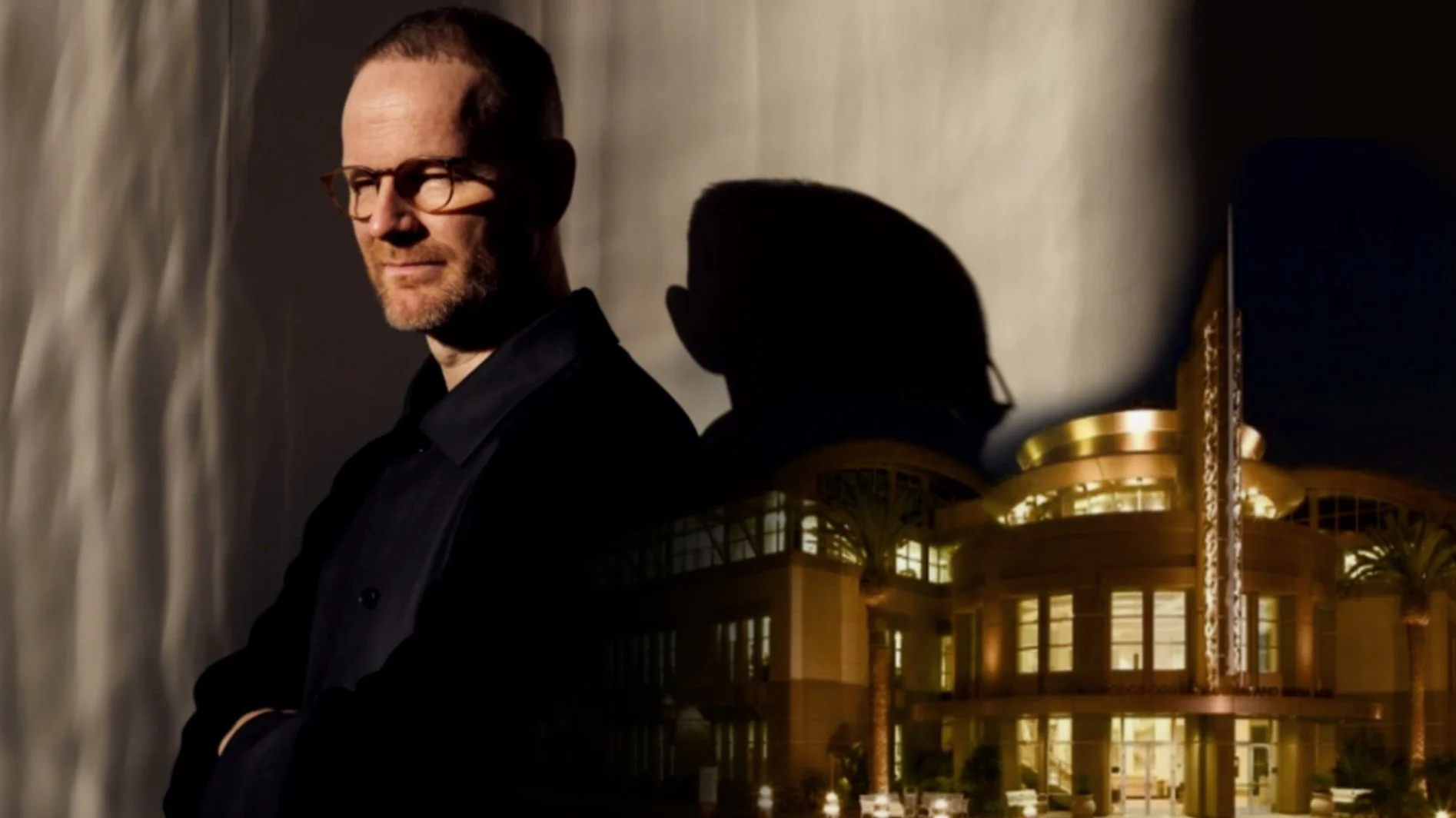
Collage by Zoe Arntsen, Illustrator
“In Norway, we don’t say ‘cut,’ we say ‘thank you,’” said Joachim Trier. “‘Takk.’”
Chapman was a school I applied to out of curiosity. Not many people from Baltimore, my hometown, had heard of it, but its size and location appealed to me: a liberal arts school small enough to build relationships with faculty, large enough to find community. Proximate to Los Angeles but remote enough to find comfort in suburbia. When I was accepted, I made my way to California for the school’s preview day, leaving behind a bitter East Coast winter and arriving at a hotel shaded by palm trees and orange groves, five minutes down the street from Disneyland.
I lathered sunblock and toured the campus, going from a panel on the psychology department’s $7 million grant for studies on free will to the Guggenheim Gallery for the graphic design senior portfolio show. I strolled past Bruxie and the farmers market into Marion Knott Studios for Dean Stephen Galloway’s panel about the developments in Dodge College.
How can a school I didn’t know about six months ago pull guests like Bryan Cranston and the cast of “Squid Game”? What else can come from a place that's contributing so many resources to my exact academic and creative interests?
I enrolled and began my journey to find out. Freshman year was filled with the standard rites of passage — I tried out different clubs, classes and friends then realized independence was heavier than I anticipated. The next year when it came time to narrow in on my future, I felt paralyzed by bounds of opportunity and contemptuous of myself for making a privilege so nebulous and distressing. One early-spring afternoon, I sought comfort in Hulu.
I scrolled until I found a movie that looked easy to watch: engaging, but not so emotionally provocative that I’d turn existential. I stumbled upon a Norwegian movie that seemingly fit this criteria called “The Worst Person in the World.” I’d never heard of it, but the main character looked vaguely like Dakota Johnson, and that semblance was inviting.
The film follows Julie (played by Renate Reinsve), a woman in her late-20s navigating career, love and identity. She goes from pursuing medical school to psychology to photography to writing, weaving through relationships and grappling with stakes as crippling as her search for purpose. When looking at a character whose only barrier to self-actualization is indecision and self-criticism, it's easy to understand why she’d condemn herself as “the worst person in the world.” But I didn’t think of her that way, she was just figuring it out. Why was I rooting for her?
Prior to Chapman, I liked movies, though I wouldn’t have called myself anything more than a casual enjoyer. I didn’t understand why some people would ask for my Letterboxd before my phone number, but I liked being surrounded by groups who could talk for hours about Dolby Atmos or “Fight Club.” “The Worst Person in the World” was the first time I’d rewatched a movie immediately after finishing it. It was also the first time I scoured Google for the filmmaker’s — not actor’s — backstory.
I dove into the rest of the “Oslo Trilogy,” a series of standalone films created by writer-director Joachim Trier. He spoke in a language I was fluent in but couldn’t verbalize for myself. The kinship with his movies felt honest, devoid of any aggrandizing inclinations to make my Letterboxd seem “cultured” in Norwegian arthouse cinema. It made more sense why my peers were so devoted to studying this medium– the reverence was primal.
“There’s a lot of smart things to do in life … Once in a while, you ask yourself: what is the purpose of art?” Trier has said. “But we know that people have always made art — look at the cave paintings in Lascaux and Chauvet. If we aren’t allowed to talk to each other through that 'other language’ of art, then we are missing something fundamentally human.”
Fast forward two years, I’m now a psychology major and a documentary film minor. Chapman’s resources have helped me work in event photography, film internships, the coffee industry and assistant teaching. I’ve gotten to take niche classes like Typography, The Documentary Tradition and Examining the Black Mirror. I have friends and hobbies and a community I care about. It’s difficult to comprehend how lucky I got to be able to live a life filled with such diverse interests, but it was made possible by a school that holds creative pursuits to the same professional and intellectual standards as more traditional college majors.
When I came back to Chapman after winter break, I walked into Marion Knott Studios to get a peak at the master class schedule for my last semester.
On Feb. 24: Joachim Trier.
How is this school real?
I went to the Folino Theater from a long Tuesday-night class block and sat amongst hundreds of other eager students to watch “Sentimental Value.” It was my third viewing. Then, my parasocial luminary materialized from side stage. Despite it being 10 p.m., Trier sat with our community and spoke to professor Scott Feinberg for almost two hours about his past life as a champion skateboarder, journey to directing and filmmaking philosophy of “tenderness (being) the new punk.” He quoted the ever-pertitent philosopher Søren Kierkegaard: “life can only be understood backwards, but it must be lived forwards.”
It's common wisdom to never meet your heroes. Chapman gives students the uncommon opportunity to challenge that. Four years ago, I had a mere nascent curiosity in film — I liked going to the theater as much as anyone else, but I don’t think I would even have been able to articulate what a film director did. Now, I had a favorite, and he was sitting in front of me. While I didn’t meet Trier, watching him speak, emote and engage in 3D has given me the confidence to say the previous maxim is false. Trier gave me a cause to revel in; Chapman gave me the capacity to seize it.
“The Worst Person in the World” ends (spoiler alert) without an absolute resolution. She doesn’t miraculously find her life’s calling and pursue it with some newfound zest. Instead, the film ends with her being content. Her life is peaceful, rather than doubtful, and she is fulfilled by her journey through her creative and personal interests.
In two months, I will say my final thank you to Chapman. In the meantime, I will say to Trier: takk.