
Spoiler alert: this article contains spoilers for “Marty Supreme.”
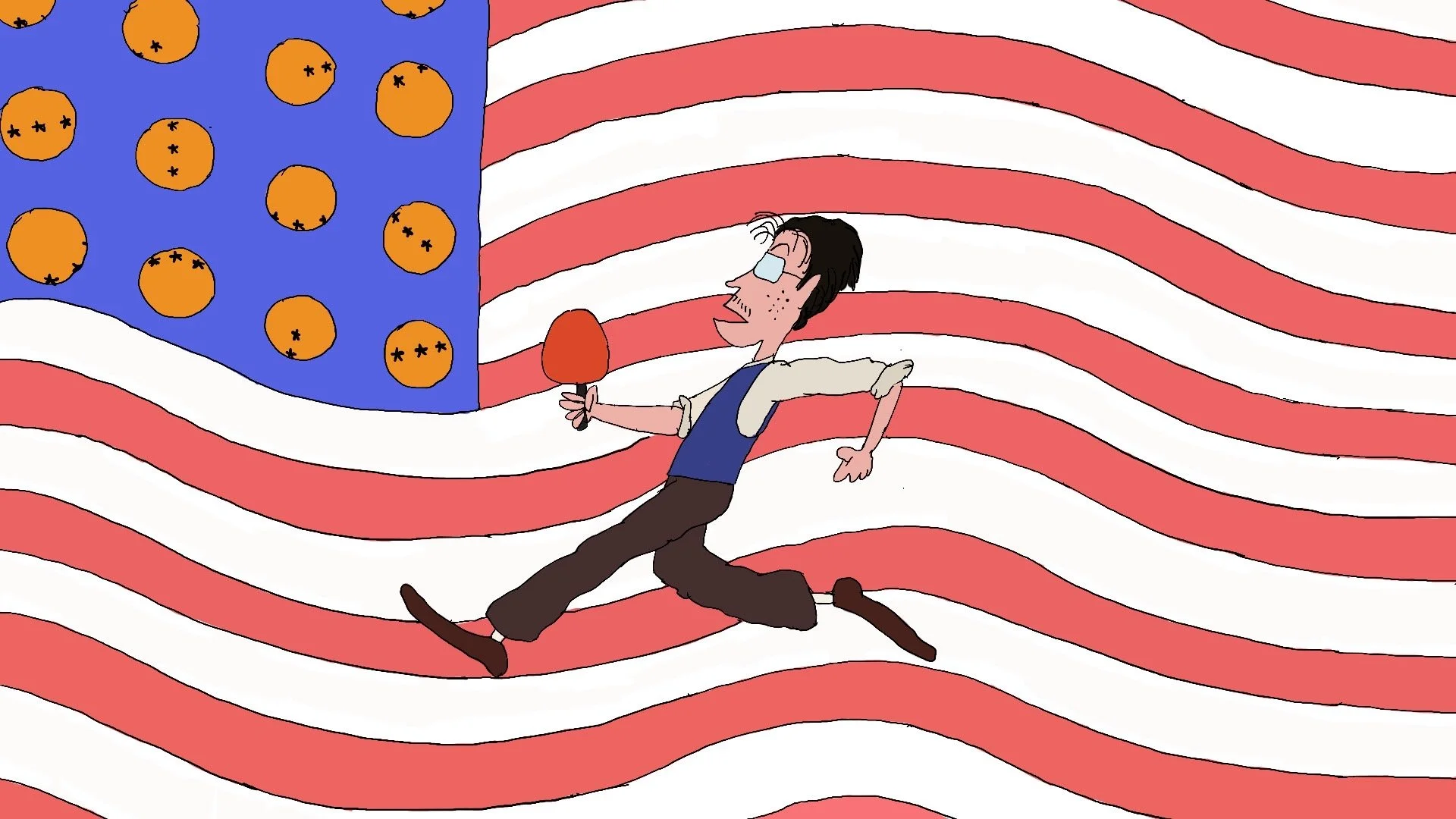
Illustration by Sami Seyedhosseini, Cartoonist
Does Trump’s second term feel different to anyone else? There are masked men in the streets, a blood red stock market and all I can wonder is why 2025 wasn’t a worse year for the movies.
Of last year’s stock, there were no films that I thought spoke to the attitudes and ills of contemporary America quite like “Marty Supreme,” but I’m not so sure that’s a good thing. The rise, fall and redemption of ping-pong savant Marty Mauser is surely captivating, but glorifies the “hustle” to the extent that it promotes a way of life in service of contemporary American fascism.
A24’s newest attempt at bridging the gap between private equity-funded festival cinema and blockbuster returns, “Marty Supreme” tells the somewhat-true story of a forgotten ping-pong champion played by America’s skinniest sweetheart, Timothée Chalamet. Partially based on real life athlete Marty Reisman, it’s important I note that despite being a big, brash character study and period piece, Chalamet’s character is an invention of the filmmakers, renamed to avoid biopic status.
Going into the film, I expected, as did many others after an excitable press tour, a sports movie finally giving ping-pong its due as a cinematic and athletic subject. But really, the majority of “Marty Supreme” follows Mauser away from the ol’ paddle ‘n’ table as he scrounges enough money to get to Japan and redeem himself after a humiliating defeat. Unfortunately, Marty doesn’t have the time to worry about his abilities as a player because he’s so eternally broke, so for the most of the runtime, he’s coasting off of pure chutzpah on his way from one grift to the next.
Despite gritty lows, Marty’s Sisyphean quest is framed by the filmmakers as aspirational. In his quick-witted, hot and hotheaded way, he’s a worthy idol for a young American working class as many of us have already rationalized our poverty by committing to a hustler’s mindset not unlike Marty’s.
But our boy Mauser takes it a step further and lets that hustler mindset rationalize his humiliation to the ends of international finance. Yikes. You see, to get to Japan, Marty ultimately has to bend to the will of millionaire businessman Milton Rockwell, played by Kevin O’Leary of “Shark Tank” (an ingenious feat of casting), who offers to take Marty overseas on the condition that he loses in an exhibition match so that Rockwell can win over some Japanese clients. Marty takes Rockwell up on the offer, only to flip the script and play until a hard-fought victory once he finds out that he’s been barred from competing in the world championship.
Despite the afterglow of victory, in Marty there roils the guilt of having his table tennis talents be weaponized as an instrument of U.S. hegemony, providing Rockwell with the necessary firepower to keep buying and selling overseas. I myself, and many other Americans, feel a similar guilt knowing that, because of global capitalism, all of the labor from our rent-paying jobs feeds the U.S. economy, the money made being used to sell weapons and conceal genocides — I believe it’s the great cognitive dissonance of our time.
For a second there, “Marty Supreme” did take shape for me as a complex deconstruction of the Great American Hustle, the man’s Herculean efforts going unrewarded as he questions his involvement in a system of exploitation. But instead of simmering in the prescience of this idea, the filmmakers provide Marty with a sudden and reactionary answer to his moral problem: parenthood.
That’s right, in its final moments, all the arrogance and aspiration of Marty Mauser is vindicated by the birth of his son, carried for the entire runtime by his childhood sweetheart who has been waiting out his absence in an abusive marriage. With his son before him and tears in his eyes, Marty realizes that even if his talents are significant only in their negative impact on the world, his real purpose has been raising a child to try and fail in the exact same way. I find this reasoning to be saccharine and pitiful, a conservative fantasy of capitalist servitude.
To be Marty Mauser, to hustle and screw without real thought or consequence and only momentum is exactly what American elites like Milton Rockwell and Donald Trump want from us. Be brash in safe, confined spaces, making money elsewhere and then settle down and start a family once you’ve been licked. Because the world definitely needs more hard-workers eager to be exploited, thinking this kind of suffering is aspirational — thinking it’s sport.