
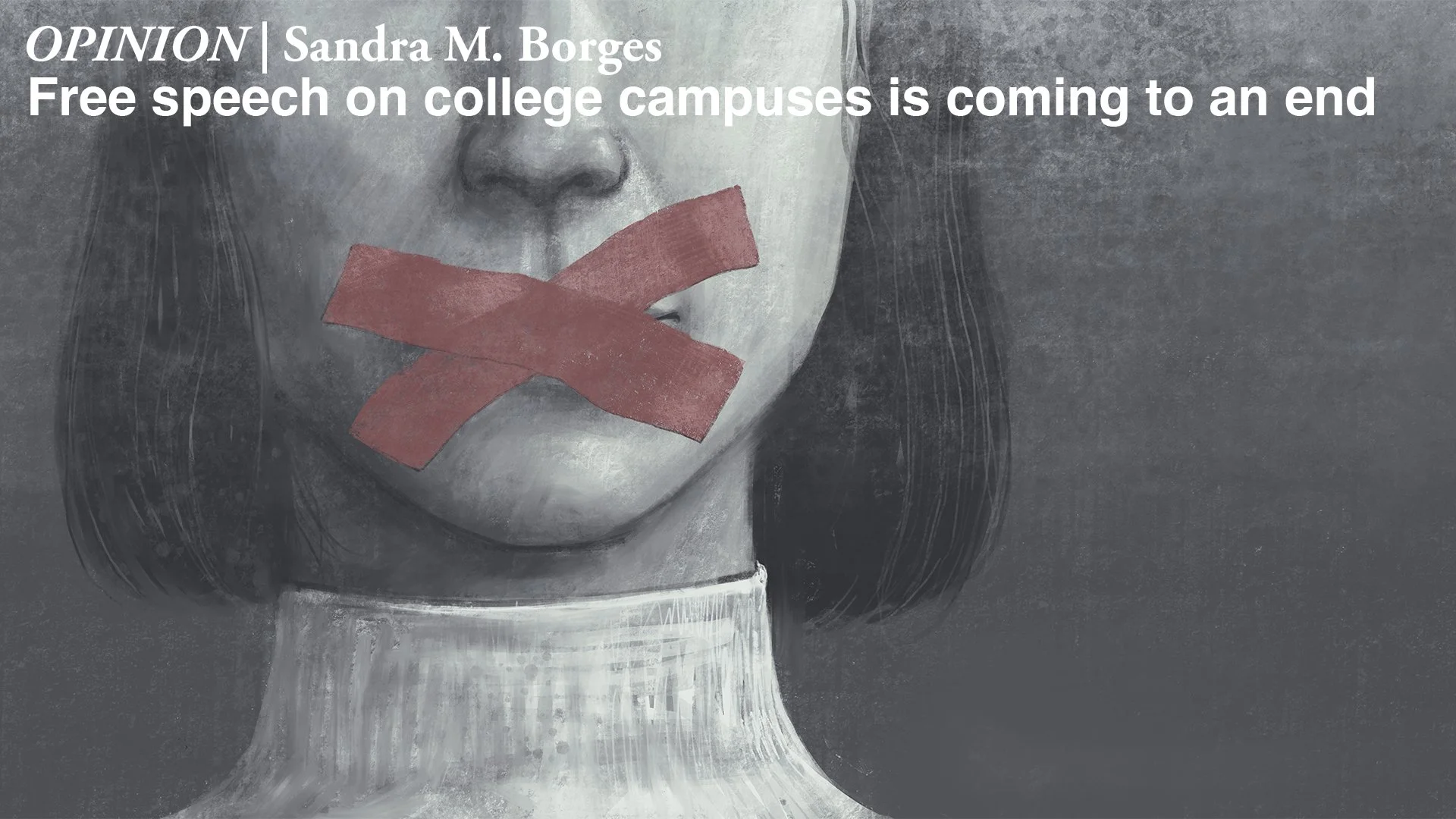
Collage by Easton Clark, Photo Editor
Is campus self-censorship a Gen Z failure? This generation is often characterized by unapologetically fighting for passion projects that influence our society, backed by a feeling of moral necessity that stems from unresolved societal crises. But surprisingly, that drive seems to come to a halt on college campuses, where the extent to which their passion translates remains uncertain. Where a fear of seeking discomfort erodes intellectual courage.
Step onto a college campus today, and you’ll find a strange, stifling silence, and that “passion” everyone talks about seems to hit a dead end the moment the conversation becomes uncomfortable. Where intellectual courage has been traded for a fragile kind of “safety,” turning the American university into a room full of people afraid of their own shadows.
Back in the day, you stepped on a college campus and your world was turned upside down. You were supposed to get offended, argue until 3 a.m. and move on the next day, coming out of it sharper and with more wit. But now, discomfort is treated as a physical injury.
Many full-time college students are now terrified to talk about the “big” stuff like politics and religion.
But the most dangerous shift isn’t just silence — it’s the way we’ve redefined harm.
When students start believing that physical force is a justified response to a speech they dislike, we’ve lost the plot. We saw this with the horrific assassination of Charlie Kirk in 2025. If students keep getting told that words are the same as fists, it shouldn’t be a surprise when they start swinging back.
There’s a clear double standard at play. Campuses are categorized as a place where freedom of expression exists — only if students stay within the lines drawn by the left.
Even at a place like Chapman, which has a reputation for being more balanced thanks to legal heavyweights like Hugh Hewitt and previously John Eastman, the spirited debate our professors call for feels more like a minefield.
Gen Z doesn’t lack heart, but the generation is certainly losing its grit. Chapman policies may improve and rankings may shift, but campus dialogue must remain alive, where curiosity over condemnation drives students to partake in making their beliefs public.