
Lacrosse learns lessons in loss
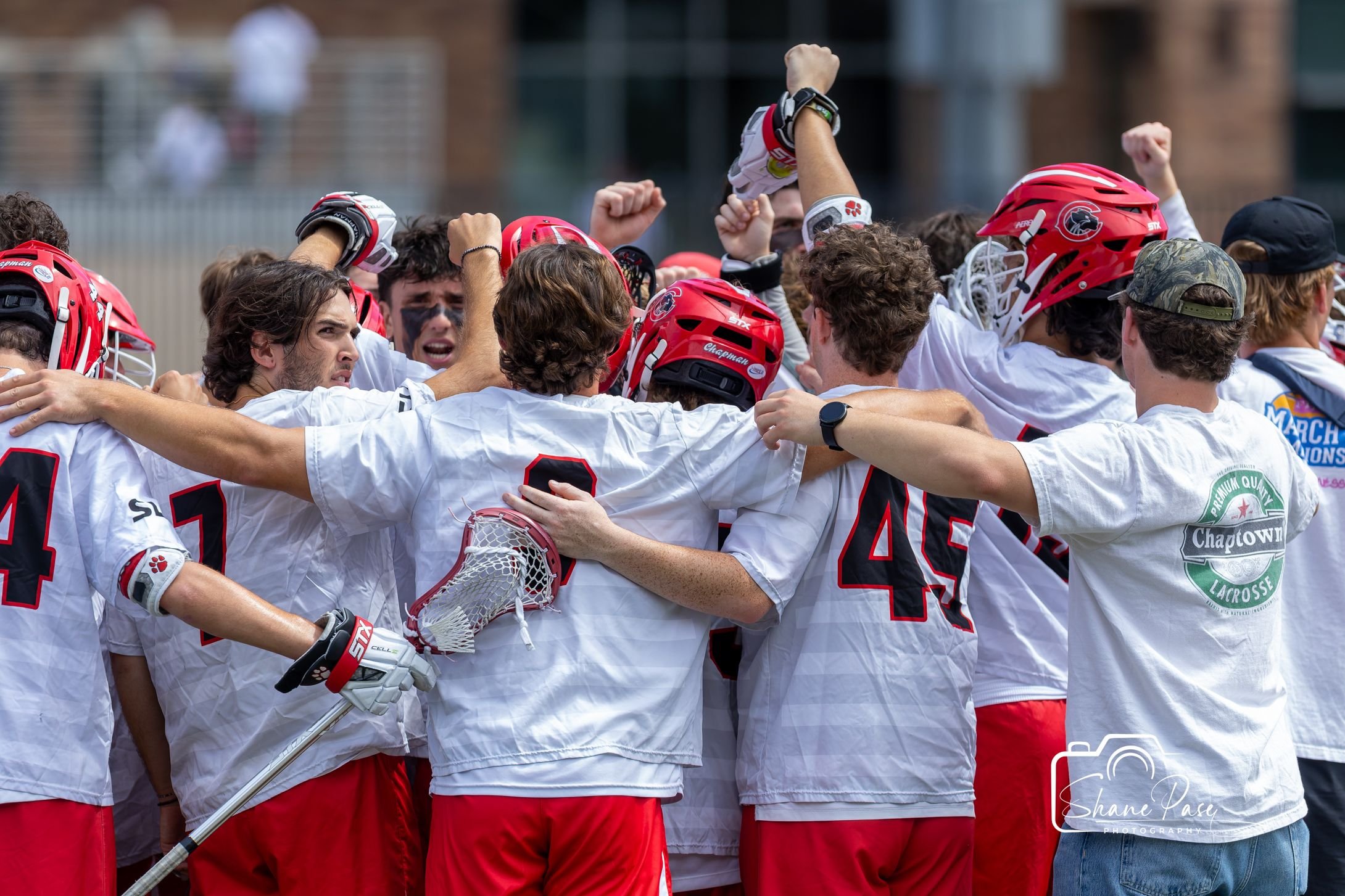
Photo courtesy of Shane Pase
The question is never whether you are going to lose. The question is what you do with it when you do.
It happens in boardrooms and classrooms, in relationships and careers. It happens on lacrosse fields in late April when a 14-7 lead becomes but a memory and a season ends on a turnover with seconds left on the clock.
For the Chapman men's lacrosse team, this season handed them more losses than most programs see in years. Four players tore their ACLs. Three more suffered season-ending shoulder injuries. A total of nine players had their season cut short.
It was a year that ended in an overtime heartbreaking loss against rival San Diego State (SDSU) in the first round of the playoffs. And yet, the people who lived through it will tell you it was one of the most important seasons of their lives.
Head coach Joel Kallas knows this program better than anyone. A Chapman alum who played at the university from 2003 to 2006 and was a captain on the team, he became head coach in 2022 and has continued to build one of the most successful programs in the Southwestern Lacrosse Conference (SLC).
This year tested him in ways he did not expect.
Midseason, his offensive coordinator left to take a full-time job. Kallas, whose background is in defense, had to take over the offense. The roster kept thinning. The losses added up.
"The moment a coach loses faith in the team is when the team loses faith in themselves," Kallas said. "You can't throw in the towel. That's not what you do in life."
Senior captain and communication studies major Nico Ursino came into the year ready to lead his team his way.
When he was an underclassman, the seniors were harder on him, and it worked. But with a younger roster, that same edge was not landing. He and co-captain Shandon Hanamoto had to change their leadership style midseason. It was not easy, but it was necessary.
"The biggest challenge wasn't really on the field stuff because all of those younger guys were really talented," Ursino said. "It was motivating guys to work hard and do all the right things.”
For Ursino, it was a lesson that extended well beyond the field.
"In hard times, that's where you really grow," he said. "I've learned a lot more about life in the past two seasons that were not as successful as the first two that were really successful."
For junior midfielder and broadcast journalism and documentary major Adam McDonnell, the end came earlier and harder. He planted wrong in the fourth quarter of a game against Michigan State, felt something give and immediately knew he had torn his ACL.
"My first thought was questioning if my lacrosse career was over," McDonnell said. "Being a junior with one year remaining, I was thinking to myself, ‘Is this it?’"
McDonnell is grinding through rehab, working toward the milestones that feel small from the outside and enormous from where he is standing: getting off crutches, getting out of the brace and walking on his own before he can think about running.
"I took being able to walk and drive for granted," he said. "That was never something I thought was going to be taken away from me … But I have a goal I'm working toward. That's being able to come back and play my senior season."
Then there was junior Tyler Pandis, a strategic and corporate communication major. If this season had a symbol, it was him.
Pandis suffered three separate injuries. A femur contusion in a preseason scrimmage kept him on crutches for two weeks. A stress fracture in his foot should have taken four to eight weeks to heal. He was back in two and a half, playing through pain with a carbon fiber plate in his cleat because he refused to sit any longer than he had to.
"You see guys with torn ACLs who wish they could be out there," Pandis said. "If you can play through pain, it makes it that much easier.”
The third injury came early in the playoff game against San Diego State. He pulled his groin, and that was it. His night was over before it started.
Chapman had already lost to San Diego State the week before the playoffs, falling 14-8 on April 17. The rematch came a week later in the first round of the SLC tournament, and for a half, it looked like a completely different story.
At halftime, it was 9-3. By the middle of the third quarter, the lead had grown to 14-7.
Then SDSU started chipping away.
A new goalie came in and started making saves. Chapman's offense stalled. The lead that felt like a cushion started to feel like a cliff. SDSU clawed its way back to force overtime against the Panthers.
"We just kind of felt the momentum shift and never got it back," Ursino said. "In the first half, we were just attacking, being aggressive, moving the ball. In the fourth quarter, it became, ‘Let's not screw this up’, as opposed to ‘Let's keep the foot on the gas.’"
On the sideline in a brace, McDonnell watched and could do nothing about it.
"When we went to overtime, I just wanted to put on my brace and say screw it," he said. "If I have to get another surgery, I have to get another surgery, but I’ve got to be there on the field."
In the final seconds of a physical overtime, SDSU had one last chance, and they did not waste it. With a final score of 18-17, Chapman's season was over.
Kallas did not make excuses about the result.
"I look back, and I definitely should have made some changes," he said. "I can't blame the players. They were playing their asses off. But there were a lot of changes I needed to make that I didn't."
Sports have a way of teaching lessons without asking permission. Prepare perfectly and still get hurt. Build a seven-goal lead and still lose. Give everything you have and still come up short.
After the game, Kallas gathered his team, and his message had nothing to do with lacrosse.
"Life doesn't always go your way," Kallas said. "But it's how you respond. You've got to have that sour taste in your mouth and use it as motivation."
Some lessons you only learn by losing. Chapman's lacrosse team spent a whole season learning them. Now they have to decide what to do with what they know.