
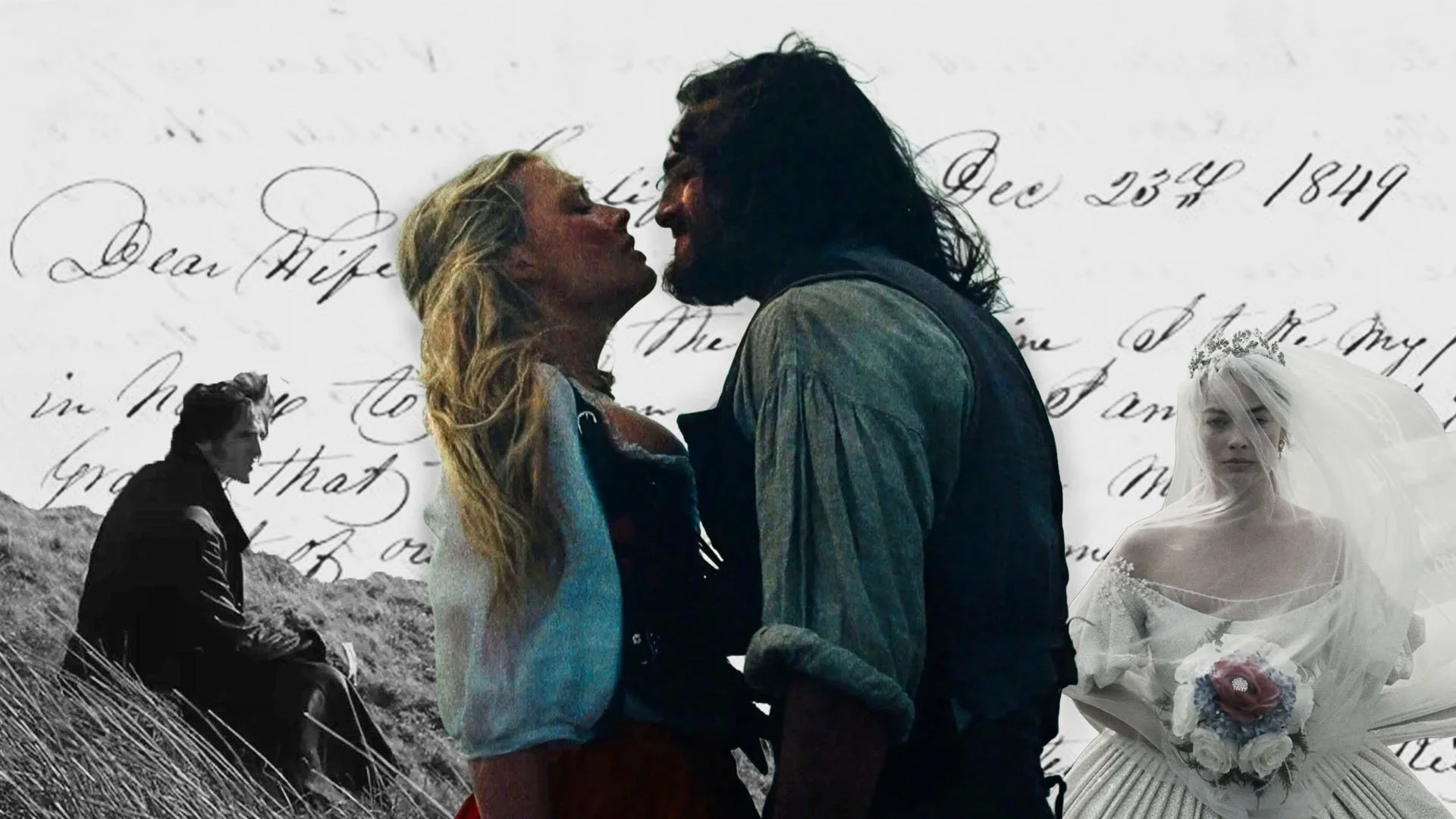
Collage by Trinity Johnson, Photographer
“I've been through every emotion and opinion about this movie under the sun,” said senior film and media studies student Nora Konrad. “When I first heard the movie was coming out, I was like, ‘What the hell? Absolutely not…’ But I'm not going to lie, I am excited for it, and I will be sat in that chair.”
For many, February is already an emotionally charged time of the year. With pressures to be in a relationship and stressful date planning, a romantic outing to the movie theater might be just the key to relief. However, Emerald Fennell’s long-awaited “Wuthering Heights” adaptation, coming out just before Valentine’s Day, seems to have only stoked more stress.
Based on Emily Brontë’s beloved classic novel, the story follows the fraught relationship between the orphaned Heathcliff and his adopted sister Catherine. While the first half centers on their romance, the book quickly leans into its gothic atmosphere, becoming a multi-generational revenge story after Catherine marries another man.
Despite the advertising touting “Wuthering Heights” as “the greatest love story of all time,” this is a dark and twisted tale that shines a spotlight on a deeply toxic relationship.
“Fennell is a provocative filmmaker,” said associate film and media studies professor Emily Carman. “This is a provocative relationship and a provocative book. So perhaps her talents are well-suited to this.”
It seems as though “Wuthering Heights” was destined for controversy from the moment it was announced nearly two years ago. After winning an Oscar for “Promising Young Woman,” Fennell’s choice to adapt Brontë’s novel came hot off the heels of “Saltburn.” As the film’s sexually explicit shock value took the internet by storm, many praised the film’s eroticism while others argued her choices lacked meaningful substance.
This lingering discourse and doubt around Fennell’s fit to adapt the material exploded with the announcement that her “Wuthering Heights” would star Margot Robbie as Catherine Earnshaw and Jacob Elordi as Heathcliff.
“The casting for this new adaptation was announced while I was teaching a class on the Brontës last spring,” recalled associate professor chair of Chapman’s English department, Lynda Hall. “(The students) were either like, ‘I love Jacob Elordi, maybe that could work,’ or, ‘That's horrible, how does that work?’”
While both actors are relatively well-regarded, discrepancies from Brontë’s novel were immediately apparent. Fans quickly raised concerns about Margot Robbie playing a character who starts the book at age 12 before dying at 16. But more prevalently, Elordi’s casting raised fan’s eyebrows as the novel describes Heathcliff as a mixed-race character.
Many readers emphasized the importance of his racial identity, as Heathcliff’s struggles with ostracization and xenophobic attitudes play into the narrative of his increasingly morally questionable actions. With direct references mentioning his race, Brontë’s writing comes in proximity to the Atlantic Slave Trade, complicating these racial depictions of Heathcliff’s character.
Fennell’s film is far from the first cinematic adaptation of the novel. After several versions featured white actors as Heathcliff, a 2011 adaptation of the story notably cast people of color in the roles of older and younger Heathcliff. Once this door had been opened, Fennell’s whitewashing of Heathcliff was seen as heavy backpedaling.
However, as others argued, each preceding adaptation of “Wuthering Heights” has also taken liberties. Perhaps the interpretive nature of the story gives Fennell some grace.
“I think that if we didn’t have other adaptations of Heathcliff for people to view on screen, I could understand the upset (contingent) more,” said sophomore writing for film and television student Brook Wellington. “I don’t find Fennell’s casting choice problematic … Fennell has made it perfectly clear she is deviating from the text in more ways than Elordi’s casting.”
Maybe the most beloved adaptation of Brontë’s novel came in the form of William Wyler’s “Wuthering Heights” in 1939. Starring Laurence Olivier as Heathcliff and Merle Oberon as Cathy, this was particularly strong as a jumping-off point for Olivier’s film career. Alongside the likes of “The Wizard of Oz” and “Gone with the Wind,” “Wuthering Heights” still managed to leave a lasting cultural impact, in what is often called Hollywood’s greatest year.
“Suddenly, (Olivier) was a big star, and he was experiencing what stars do. Fans would rip his clothes off,” said Dodge College dean Stephen Galloway, who also wrote the book “Truly Madly” on Olivier’s marriage to Vivien Leigh. “He was passionate. More than handsome, godly. He was English … there weren't that many actors to go for who could really play English right.”
While the 1939 film came at a time when casting an actor of color for Heathcliff would have been impossible with the production code banning interracial couples and enforcing white-centric narratives, star Merle Oberon’s mixed-race background adds to the history of “Wuthering Heights” adaptations and race. Keeping her Anglo-Indian heritage a secret up until her death, Oberon was forced to undergo skin-bleaching treatment to present as white for a less accepting Hollywood audience.
This historic enforcement of whiteness in “Wuthering Heights” is an integral part of Hollywood’s representational history. For many, Fennell’s evocation of the homogeneity of oppressive misrepresentation feels like a failure of the progress made through the last few decades.
“How many roles are there for a person of color in a period drama?” said Konrad. “It feels like a waste of opportunity. But I guess we'll never really know what Emily Brontë thought.”
Another central concern with Fennell’s adaptation stems from uncertainty with its tone. Fennell is no stranger to shocking and erotic twists in her films, as Tina Fey recently joked on her podcast. With the delicate and heavy subject matter of a deeply toxic relationship at the center of “Wuthering Heights,” some wonder how Fennell’s brand of eroticism will intersect with the source material and the romantic advertising.
“I'm more concerned about them passing this off, at least in some of the marketing, as a Valentine's Day movie,” said professor Carman. “This movie is about torture, obsession and tragedy. I don't know if ‘love story’ is the right attribute.”
This raises the question: how does one go about making a successful adaptation of any novel? Is such a thing even possible? With so many variables of an original author’s intent intersecting with contemporary voices, putting your own spin on a novel is a delicate process in which avoiding controversy almost seems impossible.
“(How) can you define the source of the drama for two hours from a book that might take you days and days to read?” said Galloway. “I’ve found often that the best adaptations are actually quite different from the books.”
Early reviews of the movie have been predictably split, with some praising the film's illustrious visual style and others taking great issue with its approach to the source material. Whether this rivals the 1939 film to become a defining adaptation or not remains to be seen, but the controversy surrounding Fennell’s version looks like it’s here to stay.
Editor’s Note: A previous edition of this story mis-categorized Galloway’s book “Truly Madly.” That has since been changed.