
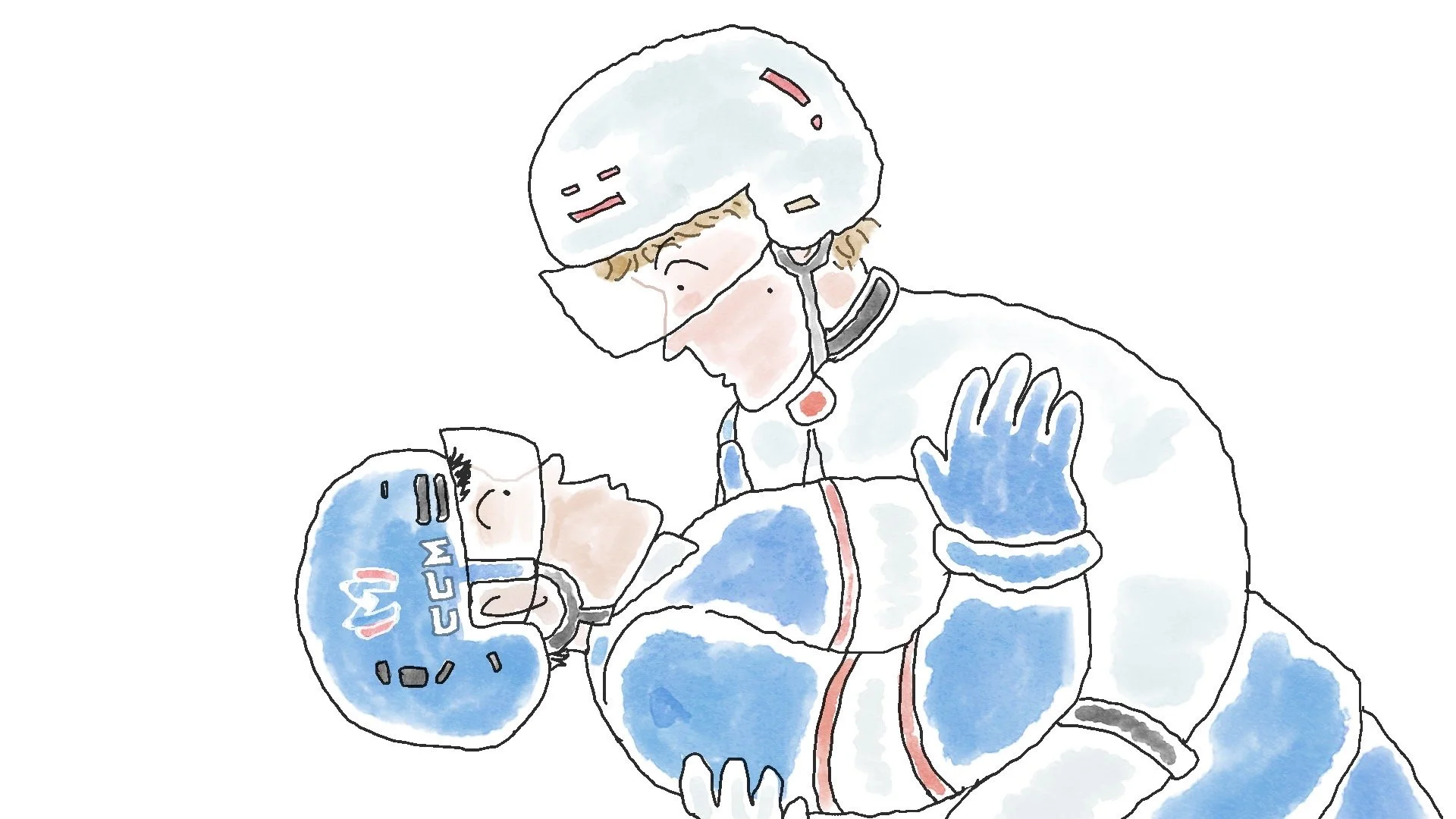
Illustration by Sami Seyedhosseini, Cartoonist
HBO’s newest hockey show has taken the world by storm. Who knew viewers loved the sport so much? The thing is, they don’t — at least not in this context. What they love are gay hockey players, specifically Shane Hollander (Hudson Williams) and Ilya Rozonov (Connor Storrie).
“Heated Rivalry” aired on Nov. 28, 2025, and somehow, almost three months later, it is still as relevant as ever. The six-episode show follows two closeted hockey rivals as they navigate their nearly 10-year-long romance. The show is based on the second book of the same name in the “Game Changers” series by author Rachel Reid.
From episode one to episode six, viewership increased by over 300%, which is no surprise given the massive fandom that has taken over social media. TikTok edits, cast photoshoots and late-night talk show interviews have skyrocketed the actors into immense fame. Williams and Storrie even served as torchbearers for the 2026 Winter Olympics.
This show has completely changed the landscape of queer media and what was once thought possible. Chapman professor and director of LGBTQ studies, Joshua Liashenko, said it’s the series' uniqueness that draws in new audiences.
“There was something different about this show, and across the board, there was just raving positive reviews, to the point where people who I was talking to (in) my own personal and professional life who weren't necessarily avid consumers of queer television media were also very interested,” said Liashenko.
Compared to other popular queer media like “Heartstopper,” which is also based on a book series, “Heated Rivalry” incorporates many explicit sex scenes, drawing in a different audience in and broadening the understanding of queer relationships.
“I think for folks who aren't queer in general, the show really gave an education concerning queer sex, and that didn't turn off audiences,” said Liashenko.
The show was directed by Jacob Tierney and produced by Crave, a Canadian streaming service, both of which played a major role in the show turning out the way it did. Other major developers wanted to withhold even a kiss until episode five, which would have completely changed the series and its path to cultural dominance.
Junior film studies major Lucy Low said the explicitness was surprising.
“I was shocked by how much they were showing, because a lot of queer media can kind of fall into being either really PG or really heartbreaking,” said Low.
The series explores sexuality from the very first episode, and that openness is central to what “Heated Rivalry” is, proving that audiences want to see these stories.
“There's definitely some media industry hang-ups within our society, and there is a wariness, especially in response to the structural toxicity that our current political environment is promoting for queer narratives — which, again, the popularity of the show here in the U.S. completely dismantled,” said Liashenko.
Sophomore communications major and president of Chapman’s Queer Student Association, Amelia Sidney, took Liashenkos' introduction to LGBTQ+ studies class, and that was what drew them to the show in the first place.
Episode three covers almost the entirety of the first book in Reid's series and follows Scott Hunter (François Arnaud), another hockey player in the league, and Kip Grady (Robbie Graham-Kuntz) as they navigate a meet-cute turned closeted romance. This episode has become a favorite amongst fans due to the complexity of their relationship and depiction of “the closet.”
“Episode three was my favorite, honestly, just because I loved Scott and Kip; it's so genuine,” said Sidney.
The show has a large number of straight female viewers despite being about gay men, and Liashenko says that is partly due to the feelings of safety that are provided when female bodies are not the center of sexual attention.
“I think it offered an opportunity to see a different take on masculinity, and that included tenderness,” said Liashenko. “Where it can be extremely erotic and very visceral, it isn't using the female body … as the focus of attraction.”
The series has made a real and lasting impact on people of all sexual orientations, but its most powerful effect is the sense of love and acceptance felt by viewers who see parts of their own experiences reflected on screen.
“I know just from the men in my life that they wish that they had something like this when they were younger,” said Low. “It's been really impactful for them, which is honestly kind of the most important thing.”