
Chapman PR and advertising makes room for AI
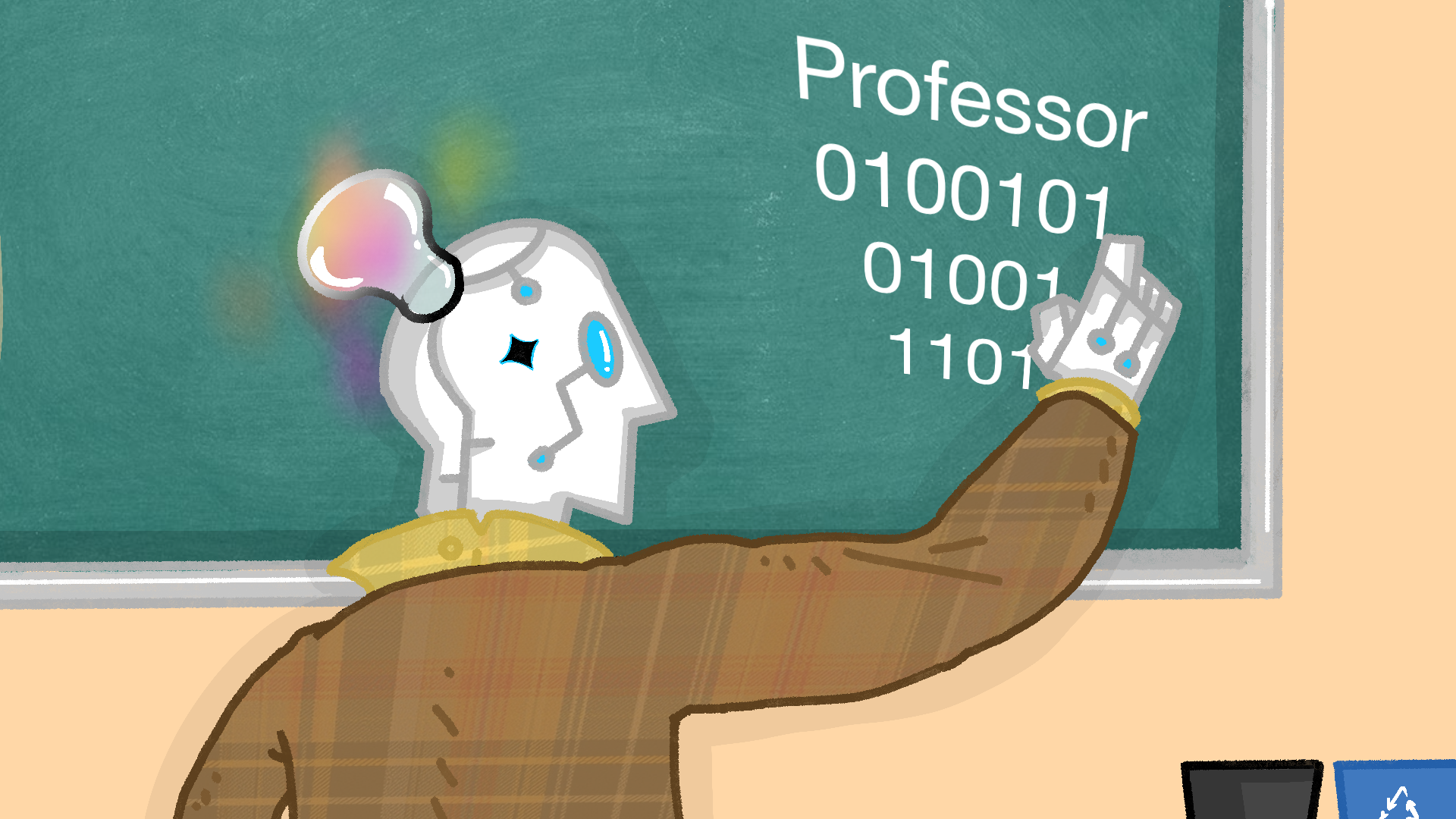
Illustration by Kamaal Samuel, Illustrator
Artificial intelligence (AI) has entered the classroom, and it’s here to stay. Following the introduction of Panther AI last spring, there has been a persistent increase in professors assigning AI-centered projects.
“Some Dodge (College of Film and Media Arts) professors say to try and test (AI) out to brainstorm or see what it comes up with photo-wise,” said Gili Adry, a senior psychology major who takes Dodge classes for her advertising minor.
Adry said that her professors often require the use of AI in assignments where design is the focal point, prompting the software to generate images and text for projects.
“I don’t have any professor who is fully against (AI) use, as long as it is used properly and not to cheat or plagiarize,” said Adry.
Christopher Trela, a public relations professional who teaches entertainment marketing, media relations and public relations (PR), regularly uses AI in his professional capacity and has incorporated it in the classroom.
“I’ve been using ChatGPT and other AI programs to help create assignments in class and homework assignments,” said Trela.
He said it is important for students to be comfortable using AI, as it plays a role in the PR and advertising industry. Trela aims to prepare the next generation of PR specialists to use the tool as leverage rather than be afraid of it.
“What I want students to know is that AI is not going away,” he said.
Public relations professionals are increasingly using AI, with 75% reporting some use in 2025. AI is being used to write the first draft of press releases and pitches, said Trela. However, the Public Relations Society of America’s code of ethics calls on professionals to make a conscious effort to ensure that the content AI provides is never the final outcome.
“I asked ChatGPT to provide a PR cycle for the launch of a new Broadway show,” Trela said. “The response was detailed and accurate.”
Another AI tool that has assisted professors and students is NotebookLM, which creates podcasts out of material, promoting AI as a learning tool tailored to individual needs.
“Don't be afraid of change, including new tech that has been introduced,” said professor Ed Collins, who recognizes room for improvement in the advertising industry.
Collins, who has worked in advertising for four decades and teaches an upper-division commercial production course, launched AI production company Firebay Studios in response to demand from the field.
“AI has blown up and become an almost mandatory part of an agency's workflow,” said Collins.
To avoid confusion in the classroom, Collins provides students with instructions on when AI can be used in assignments and for what purposes it’s prohibited.
“This train is moving fast, and in my opinion, all advertising professionals and soon-to-be professionals should be learning about AI,” said Collins.
In Collins' courses, he attempts to integrate AI into almost all assignments. He designed an audio project where students are required to use AI to generate voice, music or sound effects.
With advancements happening faster than ever, Collins encourages students to “adapt or die,” hoping they will see that AI will not replace humans — but that humans using AI will replace those who don’t.
Trela recommends using PantherAI as an entry point for students to get familiar with the concept. While it may not be as robust as ChatGPT, it fits basic student needs and is a starting point for learning AI’s abilities.
“I think it’s smart what Chapman has done,” he said. “Because they realize we’re going to be using this.”